

Your dog is staring at you across the yard. You say “come” once, then louder, then with that strained voice every dog owner recognizes. Your dog blinks, sniffs the grass, and seems to hear everything except you. Or maybe your dog does hear you, but the room is busy, the park is loud, or age is changing how sound reaches them.
That’s where dog sign language changes things.
For some dogs, hand signals are a training upgrade. For deaf or hearing-impaired dogs, they’re a lifeline. In both cases, visual communication can make training clearer, calmer, and more connected. It shifts the conversation from repeating words to using movements your dog can read well.
A lot of owners discover this by accident. They realize their dog sits faster when they lift a hand than when they say the word. They notice their dog watches shoulders, posture, and hand movement long before processing speech. That isn’t a trick. It’s communication in a form dogs naturally notice.
If your dog is restless at night and you’re also working through behavior questions at home, this guide pairs well with common reasons dogs cry at night.
Table of Contents
- Beyond Words A New Way to Talk to Your Dog
- The Foundation of Visual Communication
- Teaching Your First Five Essential Hand Signals
- Adapting Sign Language for Deaf Dogs
- Moving Toward Two-Way Conversation
- Troubleshooting Common Training Hurdles
Beyond Words A New Way to Talk to Your Dog
A dog doesn’t need to know formal sign language in the human sense to become fluent in visual cues. What matters is that your movements are clear, repeatable, and meaningful. When that happens, training starts to feel less like issuing commands and more like building a shared language.
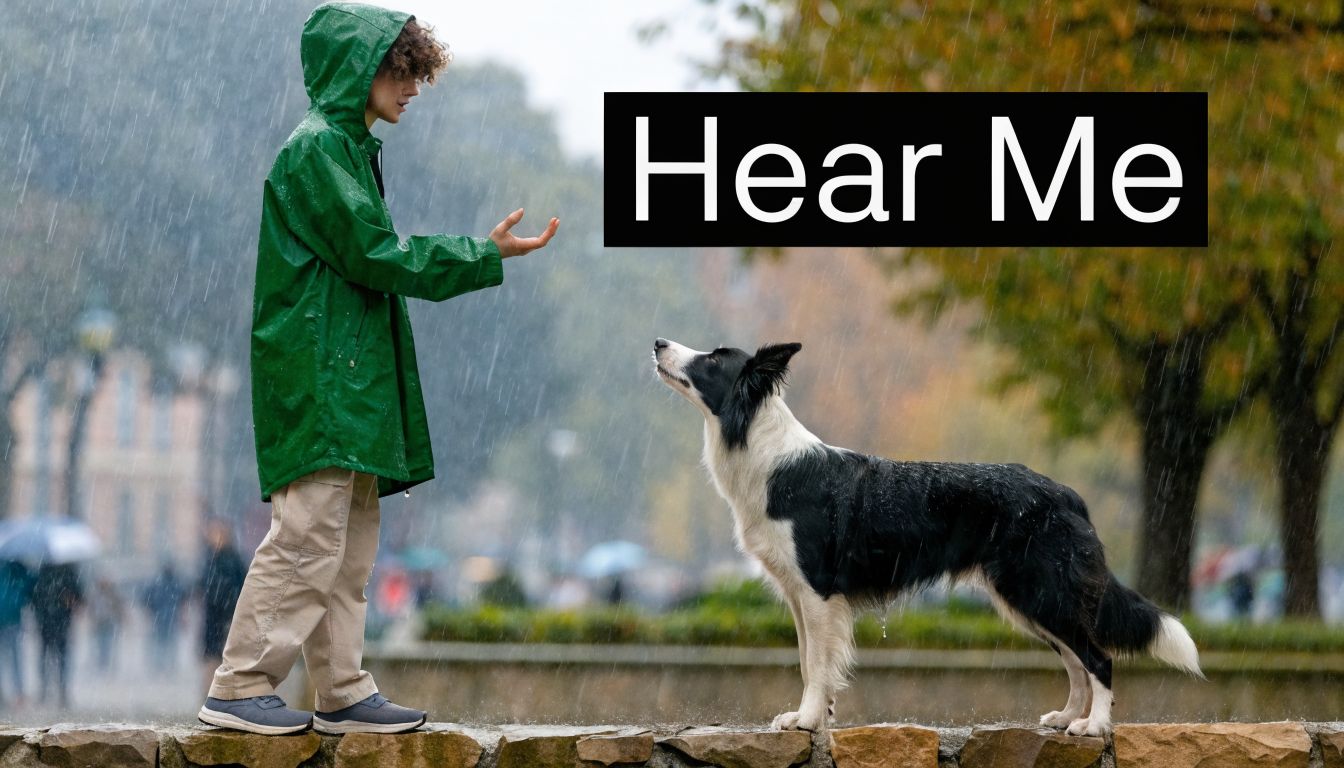
The first big shift is practical. A hand signal cuts through noise. You can cue a down at the far end of the yard, ask for a stay when guests enter, or direct your dog in a crowded park without adding more sound to an already noisy moment. Dogs often respond to that clarity with better focus because your body gives them one clean message.
The second shift is emotional. Owners often talk more when they’re frustrated. Dogs usually understand less when humans do that. Visual communication slows people down. It makes you think about timing, consistency, and what your dog is seeing. That tends to soften the whole training process.
Dogs read us all day long anyway. Dog sign language simply makes that reading intentional.
This matters for everyday dogs and not only for deaf dogs. A young, energetic Labrador can benefit from silent cues in a stimulating environment. A senior dog with fading hearing can keep training confidence. A rescue dog who’s wary of loud voices may relax when guidance becomes quieter and steadier.
Start with what your dog already notices
Most dogs already know bits of visual language before formal training starts. They know the difference between you standing tall and leaning forward. They know when your hand moves toward the leash. They know the body posture that means dinner is coming.
That’s why hand signals work so well when taught cleanly. You’re not introducing a foreign concept. You’re making your body language deliberate.
A good dog sign language routine doesn’t replace relationship. It deepens it. Your dog starts checking in with you more. You start watching your dog more closely. That mutual attention is where the essential value sits.
The Foundation of Visual Communication
The best hand signal in the world won’t help if your dog isn’t looking at you. Before teaching any formal cue, build the habits that make visual training possible.
An Italian study involving 25 dogs found they responded correctly to hand signals with 99% accuracy, outperforming verbal commands alone, which highlights how naturally dogs read non-verbal cues, according to this summary of the research on WagWalking.
Start with attention
Visual training begins with one question. How do you tell your dog, “Look here,” without already having a signal system?
Use simple, repeatable attention prompts. For a hearing dog, that may be a soft clap, kissy noise, or name cue at first. For a deaf dog, it may be a floor vibration, a light touch, or a movement into their line of sight. The moment your dog looks at you, mark it and reward it.
Practice this outside of formal training too. In the kitchen, in the yard, during calm moments on walks. If your dog learns that checking in with you pays well, every later hand signal becomes easier.
A few habits help fast:
- Face your dog clearly: Don’t hide the signal behind your body or deliver it while turning away.
- Use one position first: Standing in front of your dog is easier than teaching from the side.
- Reward eye contact quickly: If the reward comes late, your dog may not connect it to looking at you.
Choose a visual marker
A visual marker is the silent version of a clicker. Many trainers use a thumbs-up, an open palm, or a brief nod. The marker tells the dog, “Yes, that exact moment was correct.”
This becomes especially important with deaf dogs, but it also sharpens timing for any dog. If your dog sits, looks at you, or moves into position, the marker bridges the split second between the right behavior and the reward arriving.
Practical rule: Pick one marker signal and protect it. Don’t reuse it casually during daily life.
If you choose thumbs-up, use that only to mark success. Don’t mix it with “stay,” “wait,” or a random gesture during conversation. Dogs learn faster when one sign has one job.
Reward what you want fast
Positive reinforcement is what turns a hand movement into communication instead of guesswork. Use a reward your dog values most. For some dogs that’s chicken, cheese, or soft treats. For others it’s a tug toy, a tossed ball, or social praise paired with touch.
Start with a high rate of reinforcement when teaching a new sign. You’re not bribing. You’re building meaning. Once the dog understands the gesture, you can fade the lure and make rewards less predictable.
Here’s the part many owners miss. Your body has to stay consistent too. If your “sit” signal changes every few reps, your dog isn’t being stubborn. Your dog is decoding a moving target.
Teaching Your First Five Essential Hand Signals
The simplest way to teach dog sign language is to begin with behaviors your dog is likely to offer or can be gently lured into. Sit is the easiest starting point for most dogs because the motion is natural and easy to reward precisely.
Teach sit first
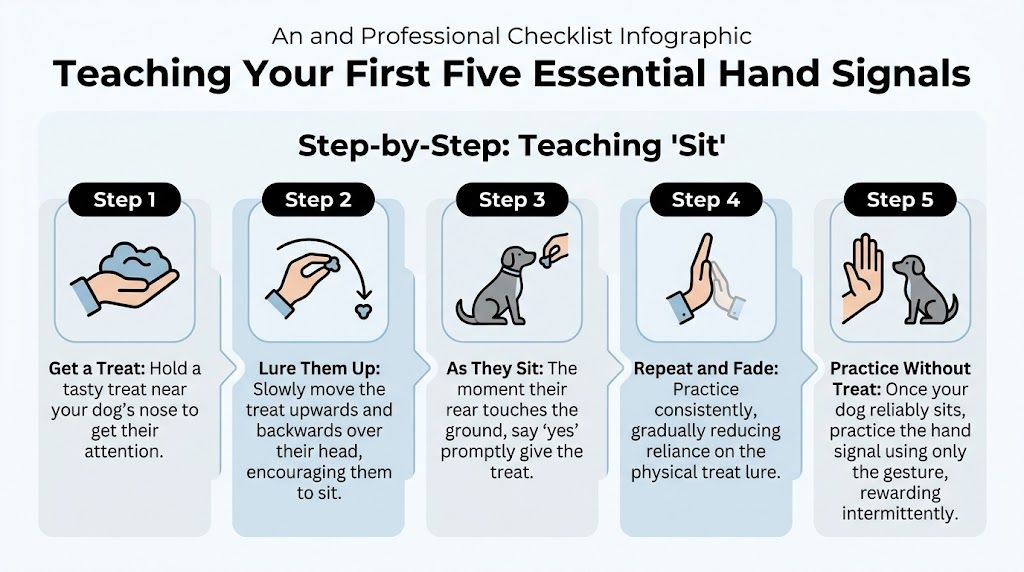
Hold a small treat close to your dog’s nose. Slowly move it upward and slightly back over the head. Most dogs will lift their head, shift weight backward, and lower their rear to the ground. The moment that happens, give your visual marker and reward.
Repeat that motion several times so your dog starts following the path smoothly. Then begin to turn the lure into a signal. Your hand still makes the same upward motion, but the treat can move to the other hand or appear after the marker.
This stage determines whether owners either make fast progress or accidentally stall it. If you keep showing the food in the signaling hand forever, your dog may follow the snack instead of learning the gesture. Fade the visible lure as soon as the motion itself starts making sense.
Later in the session, try the same hand motion with no treat visible. If your dog sits, mark and reward from your other hand or pocket. That’s the moment the sign becomes meaningful.
A training tool that can help with control during early practice, especially for strong dogs, is properly fitted walking gear. If you’re also choosing equipment, this guide to a dog harness for German Shepherd use and fit considerations can help.
To see a visual example in motion, this short video gives a useful demonstration:
Five Essential Dog Hand Signals
| Sign | Hand Gesture | Training Tip |
|---|---|---|
| Sit | Raise one hand upward from the dog’s nose level in a small arc | Start with a lure, then keep the same motion while removing the visible treat |
| Stay | Hold a flat palm toward your dog like a stop sign | Reward very short pauses first, then build duration slowly |
| Come | Sweep your arm inward toward your chest | Make this sign valuable. Reward generously every time in early practice |
| Down | Move your hand from nose level down toward the floor | If your dog resists, lure in small steps instead of pushing for a full down |
| Look at Me | Point two fingers toward your eyes or make a distinct eye-contact gesture | Reward fast glances first, then build longer eye contact over time |
How to keep sessions productive
Training quality matters more than marathon practice. According to this dog signal training guide from iPuppee, sessions should last 5 to 10 minutes, 3 to 5 times daily. The same guide notes that inconsistency in signal shape or speed can create 40 to 50% confusion in early trials, and relying too heavily on verbal cues can delay visual independence by 2 to 4 weeks.
That lines up with what trainers see every day. Short sessions keep your dog eager. Repetition with clean form builds understanding. Long, muddy sessions create fatigue and sloppy communication.
Use this rhythm:
- Pick one sign only: Don’t teach sit, down, and come all in the same brand-new session.
- Get the behavior first: Help your dog succeed with a lure or setup.
- Mark the exact moment: Your visual marker tells your dog what worked.
- Reward right away: Fast reinforcement builds clarity.
- Stop while it’s going well: End before your dog gets mentally tired.
If progress suddenly drops, check your own hands before blaming your dog.
Adapting Sign Language for Deaf Dogs
For a deaf dog, visual communication isn’t enrichment alone. It’s daily infrastructure. Meals, rest, recall, movement through doorways, vet handling, and safety in public all depend on signals the dog can perceive.
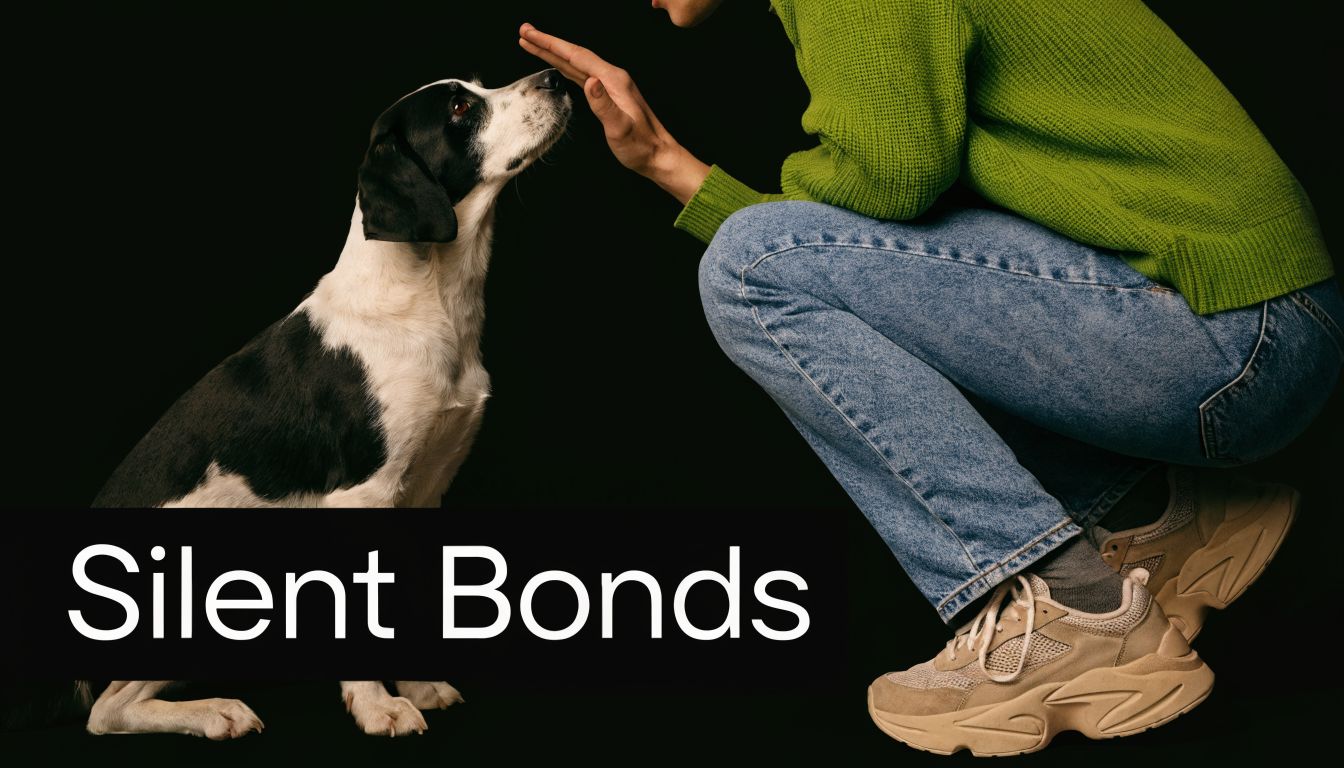
The biggest mistake people make is treating deaf dog training as standard obedience with the spoken word removed. That’s too narrow. A deaf dog also needs a reliable way to notice you, feel safe when touched unexpectedly, and understand what happens next.
Getting attention without sound
You need a non-verbal attention system before anything else works.
That can include:
- A gentle floor stomp: Useful indoors when your dog can feel vibration.
- A light touch: Best introduced carefully so your dog doesn’t startle.
- A flashlight beam or light cue: Helpful at a distance or in dim conditions.
- A vibrating collar: This means vibration only, not a shock collar. The vibration becomes a cue to look at you, not a punishment.
Condition the attention cue the same way you condition a hand signal. Cue it, wait for eye contact, mark visually, reward. Over time, your dog learns that vibration or touch means, “Find me for the next instruction.”
Many deaf dogs also benefit from a clear “all good” signal. That might be your visual marker, a soft chest touch followed by food, or a familiar hand sign that means safety and success. It helps after grooming, handling, waking, or any surprising event.
Safety matters more than most guides admit
Training a deaf dog well still doesn’t erase real-world risk. One major gap in deaf dog resources is emergency preparedness, including how owners can safely recall a dog off-leash and what liability concerns apply when verbal control isn’t possible, as discussed in this overview of deaf dog safety concerns from Proven Dog Training.
That matters because a deaf dog can’t hear a panicked shout when a gate is open, a bicycle appears, or another dog charges in. Planning has to happen before that moment.
A responsible setup includes:
- Secure physical management: Fenced areas, long lines, and thoughtful leash use.
- Clear identification: Tags or visible markers that tell others the dog is deaf.
- A practiced emergency cue: One distinct visual recall signal paired with excellent rewards.
- Household consistency: Everyone should use the same attention cue and the same core signs.
A deaf dog can live a rich, skilled, happy life. The owner just has to build safety into the routine instead of assuming voice will cover mistakes.
Daily life with a deaf dog
Deaf dogs often thrive when the home feels predictable. Approach within sight when possible. Don’t wake them by grabbing suddenly. Pair handling with reinforcement. Let them know when you’re leaving a room if they rely heavily on visual check-ins.
One more practical point. Don’t rush off-leash freedom. Even with strong training, visual recall depends on line of sight, distance, and environment. Many owners do best treating off-leash access as a privilege reserved for carefully managed spaces.
The emotional side matters too. Deaf dogs can become wonderfully attentive because they learn to watch their people closely. If you meet that attention with patience instead of pity, the bond can become exceptionally strong.
Moving Toward Two-Way Conversation
Training often stops at commands. Sit. Stay. Come. Down. That’s useful, but it leaves a lot of communication on the table. Dog sign language becomes much more powerful when the dog can also initiate.
Sean Senechal’s K9Sign system was built around that idea. It enables dogs to signal over 25 distinct needs using paw and nose touches, and trained dogs have reached 80 to 90% accuracy after 4 to 6 weeks of training, according to this K9Sign summary.
From commands to requests
This changes the relationship in a practical way. Instead of waiting for whining, pacing, staring, or barking, you give your dog a structured way to ask. The dog learns that communication works better than escalation.
A dog can learn patterns such as touching the door area to ask out, contacting the water bowl area when thirsty, or bringing a specific toy to initiate play. These aren’t party tricks. They reduce frustration on both sides because the dog has a clearer route to being understood.
The key is consistency. If nose-to-door means potty, it shouldn’t sometimes mean backyard play and other times mean nothing. The dog needs a clean outcome tied to the signal.
What to teach your dog to ask for
Start with needs that matter to your dog every day.
Good options include:
- Outside: A nose touch to the door or a target near it.
- Water: A paw or nose touch near the bowl area.
- Play: Bringing one designated toy or touching a play target.
- Rest or comfort: Going to a mat and offering eye contact for support or calm interaction.
Keep the setup simple. Create one behavior, one meaning, one predictable response. If your dog offers the correct signal, honor it whenever reasonable. That teaches your dog that communication has value.
When dogs can ask, owners stop guessing so much.
This style of training also gives active, intelligent dogs more mental work. They aren’t only obeying. They’re participating. For many households, that’s where training starts to feel less mechanical and more like real companionship.
Troubleshooting Common Training Hurdles
Even good dog sign language training can wobble for a while. Most problems come from timing, inconsistency, or asking for too much in the wrong environment. Here’s how to sort the common ones out.
My dog only responds when I also say the word
You probably faded the verbal cue too slowly or kept pairing it every time. Start giving the hand signal first. Pause. If your dog begins the behavior, great. Mark and reward. If not, help with the verbal cue only after the pause.
That pause matters. It gives your dog a chance to process the visual cue as its own instruction.
My dog seems confused by different signals
Look for overlap in your gestures. A stay and a look-at-me cue can blur together if both involve a raised hand near your face. Tighten each signal so the shape, position, and movement feel different.
Film yourself if needed. Owners are often more variable than they realize.
My dog won't look at me in distracting places
You moved too fast into a hard environment. Go back to easier practice and rebuild attention before asking for formal cues around bigger distractions. For some dogs, “look at me” needs separate training before the rest of dog sign language becomes reliable outdoors.
If your dog also seems stressed, panty, or unfocused, it’s worth checking whether arousal or discomfort is part of the picture. This article on why a dog may be breathing heavy can help you think through non-training causes.
My deaf dog startles when I touch them
Don’t make touch the first notice cue if your dog isn’t comfortable with it yet. Build positive associations during calm moments. Touch gently, give your visual marker, then reward. If startle remains strong, use vibration or movement in the dog’s visual field more often while touch confidence develops.
My dog does the sign at home but not in the yard
That’s normal. Dogs don’t generalize well automatically. Practice the same cue in several easy locations before expecting it to hold up around birds, smells, guests, or other dogs.
Keep going. Clear hands, good timing, and patient repetition usually solve most training problems faster than adding more words ever will. When dog sign language clicks, obedience improves, but that’s not the whole win. The bigger win is that your dog starts looking for you, and you start listening with your eyes.
If you want more practical, kind, step-by-step pet care guidance, visit MyPetGuider.com. It’s a helpful resource for new owners, adopters, and long-time pet parents who want clear advice they can use right away.


Leave a Comment