

You’ve probably already done the cutest part. You picked up the kitten, carried them home in a little carrier, and spent the first hour watching them sniff every corner like they’ve been assigned a serious inspection job. Then feeding time arrives, and the nerves kick in.
Should you buy pâté or gravy? Do kittens really need special food? Is wet food better, or are you overthinking it? If your kitten eats half a spoonful and walks away, is that normal or a problem?
Those questions are common, and they don’t mean you’re doing anything wrong. They mean you care. New kitten owners often feel a strange mix of joy and pressure, because feeding feels like one of the first big health decisions you make.
The good news is that choosing the best wet cat food for kittens gets much easier when you stop relying on front-label marketing and start using a simple scorecard. Once you know what matters, you can look at any can on the shelf and judge it with much more confidence.
Table of Contents
- Bringing Your New Kitten Home
- Why Wet Food Is a Great Choice for Kittens
- Decoding Kitten Nutritional Needs
- How to Read a Kitten Food Label
- Top Wet Kitten Food Picks for 2026
- Your Kitten's First Year Feeding Plan
- Becoming a Confident Pet Parent
Bringing Your New Kitten Home
The first night with a kitten often looks the same. They explore for ten minutes, sprint sideways for no reason, fall asleep in a strange spot, and wake up hungry when you’re trying to read food labels with one eye open.
That’s when many owners realize how much advice is floating around online. One article says dry food is fine. Another says only wet food. A third gives you a long list of ingredients without explaining what any of them do. It’s easy to feel like you need a veterinary nutrition degree just to buy dinner.
You don’t.
A healthy feeding routine starts with a few calm basics. Your kitten needs food made for growth, a texture they can handle, and a routine that matches their tiny stomach and high energy needs. If you’re also working through the usual new-pet checklist, practical care guides like this one on choosing flea spray for cats can help you organize the non-food side of kitten care too.
New kitten care feels big because everything is new at once. Feeding gets much less stressful when you focus on a few non-negotiables instead of trying to master every opinion online.
The main thing to remember tonight is simple. Your kitten is not a small adult cat. They’re in a rapid growth stage, and their food needs to support that. Once you know how to spot the right kind of wet food, shopping becomes much more straightforward.
Why Wet Food Is a Great Choice for Kittens
Wet food makes sense for many kittens because it does two jobs at once. It feeds them and hydrates them.
Think hydration first
Kittens don’t always drink as much water as owners expect, so moisture in food matters. Wet cat foods typically contain 70-80% moisture, compared with dry kibble at 10-12%, and veterinary studies cited by Cats.com report that kittens fed exclusively wet food during their first year show 40-60% lower incidence rates of urinary tract issues than kittens fed dry-only diets, according to Cats.com’s canned cat food review.
A simple way to think about it is this. Wet food is closer to a hydrating stew. Dry kibble is closer to a cracker. Both can provide calories, but only one brings in a lot of water with every bite.
That moisture matters because a growing kitten’s urinary system and kidneys are still developing. Better hydration supports urine dilution, which helps reduce the chance of mineral buildup.
Wet food also helps with appetite and texture
Many kittens find wet food easier to eat because it’s soft, aromatic, and simple to lap up. That can be especially helpful for a shy new arrival who’s still adjusting to your home. A food can be nutritionally strong on paper, but if the kitten won’t eat it, that nutrition doesn’t help much.
Wet food also makes portioning easier for many owners. You can see what was eaten, refrigerate what’s left, and serve meals in measured amounts instead of leaving a full bowl out all day.
Here’s where owners often get confused:
- “Does wet food spoil faster?” Yes, so leftovers shouldn’t sit out long. Serve small meals.
- “Can kittens eat only wet food?” Many can, as long as the food is complete and balanced for growth.
- “Is gravy better than pâté?” Texture preference matters, but the nutrition statement on the label matters more.
Practical rule: If your kitten is young, small, or a little picky, wet food often gives you the easiest path to good hydration and consistent eating.
That doesn’t mean every wet food is a great wet food. Some are much better suited to growth than others. The difference comes down to what’s inside the can, and how well your kitten can use it.
Decoding Kitten Nutritional Needs
A kitten’s body is working like a construction site. New muscle, bone, organs, brain tissue, and immune defenses are all being built at once. That’s why kitten food needs to do more than just satisfy hunger.
The kitten growth formula
One of the clearest ways to judge the best wet cat food for kittens is to look at growth nutrition in plain language.
Start with protein. Kittens require a minimum of 30% crude protein on a dry matter basis, according to PetMD’s vet-verified wet cat food guidance. That’s the floor, not the dream target for every formula.
Then consider the rest of the growth picture:
- Animal-based protein: Chicken, turkey, fish, and similar ingredients help support muscle and tissue development.
- DHA: Many kitten formulas include DHA to support brain and vision development.
- Balanced minerals: Calcium and phosphorus need to be balanced for healthy skeletal growth.
- Taurine and other amino acids: These support normal development and body function during the first year.
A helpful analogy is the difference between feeding a toddler and feeding a marathon runner. Both need food, but the body priorities are different. Kittens are building themselves while burning energy fast.
Why protein source matters
Owners often focus only on the percentage on the can. The source matters just as much.
High-quality wet kitten foods use animal-based proteins with 85-95% digestibility rates, while plant-based proteins are cited at 60-70% digestibility rates in the same PetMD guidance. Digestibility means how much of that protein your kitten can break down and use.
That’s why chicken listed near the top of the ingredient list is more useful than a formula that leans heavily on plant ingredients for protein.
A higher number doesn’t help much if your kitten can’t use the nutrient efficiently. Digestibility is the difference between food that looks strong on the label and food that actually supports growth.
Your kitten nutrition scorecard
Here’s a simple scorecard you can use in a store aisle or while browsing online. You don’t need to grade every food with perfect precision. You just need a consistent framework.
| Scorecard category | What to look for | Why it matters |
|---|---|---|
| Growth suitability | AAFCO statement for growth or “complete and balanced” for kittens | Confirms the food is meant for this life stage |
| Protein quality | Named animal proteins near the top of the list | Better fit for a carnivorous kitten |
| Digestibility | Animal-based ingredients that are easier to absorb | Helps a young digestive system use the food well |
| Moisture support | Moisture-rich wet formula | Supports hydration and urinary health |
| Development extras | DHA and balanced mineral profile when listed | Supports brain, eye, and bone development |
If you use that scorecard, you’ll stop asking, “What’s the fanciest can?” and start asking, “Does this formula match what a kitten needs?” That’s the better question.
How to Read a Kitten Food Label
The back of the can is where the useful truth lives. Front labels say things like “tender,” “savory,” or “natural,” but those words don’t tell you whether the food is appropriate for a growing kitten.
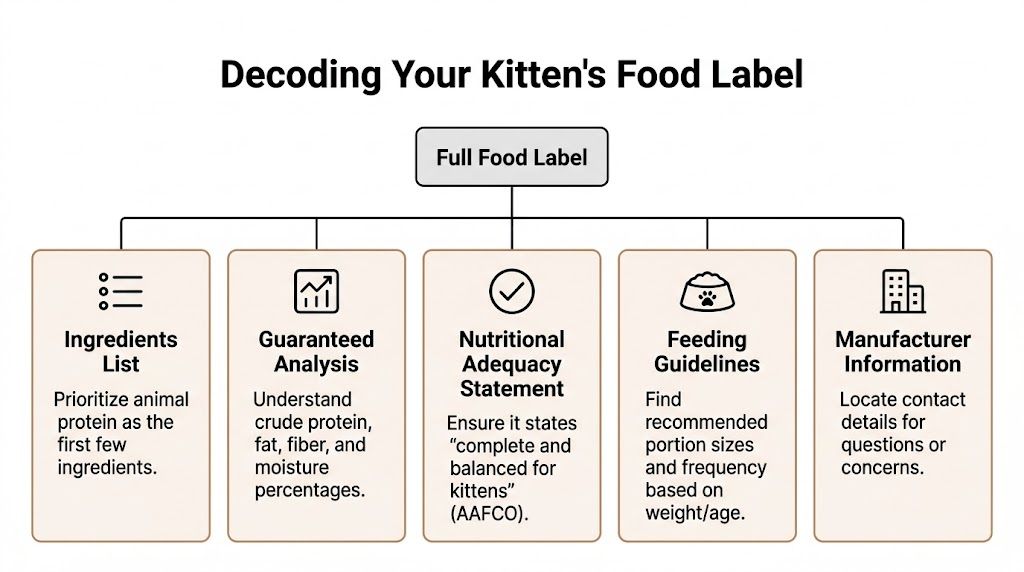
Start with the AAFCO statement
This is the first line I’d check if we were standing in a pet store together. Look for language that says the food is complete and balanced for growth or for kittens.
That statement matters because it tells you the formula is intended for the life stage your kitten is in. If the food is only for adult maintenance, put it back for now.
Then scan the ingredient list
Ingredients are listed by weight, so the first few items tell you a lot. For kittens, I like to see named animal ingredients early in the list, such as chicken, turkey, or fish.
A quick practical checklist:
- Good sign: Named animal proteins appear early.
- Proceed carefully: The label sounds appealing, but the first ingredients don’t clearly point to meat-based nutrition.
- Important context: Ingredient lists don’t tell the whole story by themselves. They work best when paired with the AAFCO statement and the guaranteed analysis.
If you compare several labels regularly, resources that discuss ingredients in plain language, such as this guide to cat food with coconut oil, can also help you get more comfortable with what different formulas include.
Use the guaranteed analysis wisely
The guaranteed analysis gives you figures for crude protein, fat, fiber, and moisture. It’s useful, but it can confuse people because wet foods contain so much water.
That means two foods can look similar at first glance, but once you account for moisture, one may provide more protein in the food’s dry matter. If a brand or a trusted veterinary review gives dry matter comparisons, that can make side-by-side judging easier.
When you read the label, follow this order:
- Life stage first. Is it for kittens or growth?
- Protein source second. Are the first ingredients clearly animal-based?
- Guaranteed analysis third. Does the food appear appropriate for a growing kitten?
- Feeding directions last. Use them as a starting point, then adjust with your veterinarian if needed.
The label doesn’t need to be exciting. It needs to be clear. A boring can with the right nutrition is a better choice than a fancy label with vague promises.
Once you’ve done this a few times, you’ll be surprised how quickly your eye goes to the important parts.
Top Wet Kitten Food Picks for 2026
Instead of handing you a random list, let’s use the scorecard. The strongest examples are the foods that clearly show kitten-specific nutrition, strong moisture support, and protein quality that fits growth.
2026 Wet Kitten Food Comparison
| Product | Protein (Dry Matter) | Moisture % | Key Feature | Price Point |
|---|---|---|---|---|
| Royal Canin Wet Kitten Food | 53.03% | 80.2% | High protein and high moisture in a kitten-specific formula | $54.96 for 24 cans |
| Hill's Science Diet Wet Kitten Food | Qualitatively described as high-quality protein from chicken and liver, supporting 50-60% daily caloric needs from protein | 78-82% | Added DHA and AAFCO growth support | ~$1.96 per can in 24-packs |
Royal Canin Wet Kitten Food
Royal Canin Wet Kitten Food is a strong example of how the scorecard works in practice. Healthline’s expert-vetted review identifies it as the top-rated wet cat food for kittens in 2026, with 53.03% protein and 80.2% moisture, and notes pricing of $54.96 for 24 cans in its roundup of the best cat food options.
Why it scores well:
- Growth fit: It’s positioned as a kitten-specific wet food.
- Protein strength: The protein level is high for rapid development.
- Hydration support: The moisture content is excellent for a young cat who may not drink much on their own.
- Practical use: It fits owners who want a straightforward veterinary-style formula without having to decode trendy marketing claims.
This is the kind of food I’d describe as reassuring. It does not need a flashy story. It lines up well with what a growing kitten needs.
Hill's Science Diet Wet Kitten Food
Hill’s Science Diet Wet Kitten Food also scores well, especially for owners who want a formula frequently discussed in veterinary settings. PetMD’s vet-verified kitten food review highlights its high-quality protein from chicken and liver, notes support for 50-60% daily caloric needs from protein, includes DHA at 0.1-0.5%, and describes moisture content around 78-82% in its overview of best kitten foods.
Why it stands out on the scorecard:
- Protein quality: Chicken and liver are easy for owners to recognize as animal-based ingredients.
- Development support: Added DHA is a meaningful plus during early growth.
- Moisture range: It supports hydration well.
- Buying simplicity: It’s widely recognized, which can make repeat purchasing easier.
If your kitten is a little selective about texture or smell, Hill’s is worth considering because palatability often matters more in real life than owners expect.
What about other brands
Here, the scorecard becomes more useful than any top-ten list.
Some kitten owners want grain-free formulas. Others need a softer texture, a smoother pâté, or an ingredient list that feels simpler to them. Those preferences are understandable, but they should come after the basics:
- Kitten-specific nutrition
- Animal-based protein
- Good moisture content
- Clear labeling
- A formula your kitten eats readily
You may also come across review roundups, including product comparisons on sites like MyPetGuider.com, that help you sort options by format, ingredient emphasis, or budget. That can be useful once you know how to judge the foods yourself.
If a brand isn’t one of the two examples above, don’t assume it’s automatically poor. Turn the can around. Use the scorecard. If it meets the growth standard and lines up with the nutrition markers you now understand, it may still be a good fit.
Your Kitten's First Year Feeding Plan
Buying the right food is only half the job. Serving it in a way that fits your kitten’s age, appetite, and development matters just as much.
A simple feeding rhythm
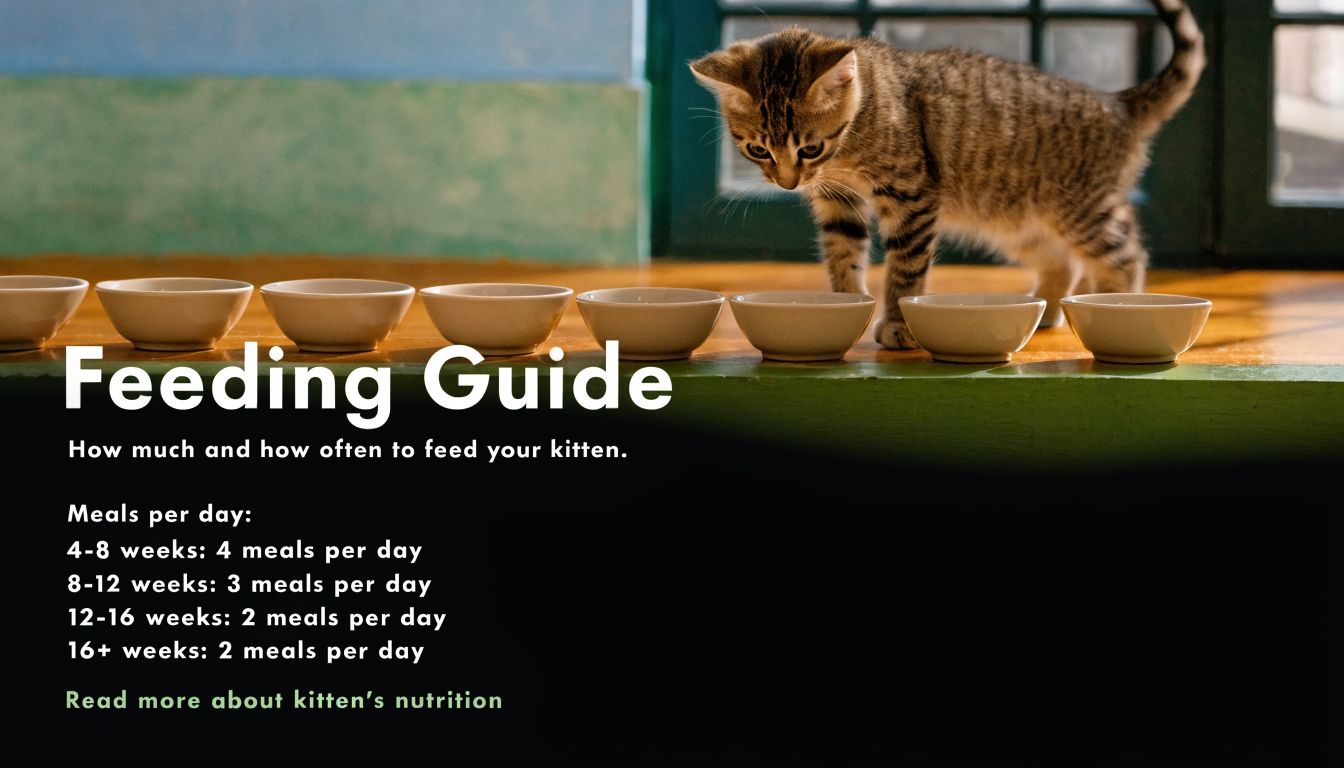
Young kittens usually do best with small, frequent meals. Their stomachs are tiny, and they burn through energy quickly. If you put down one large meal, they may nibble, walk away, and leave you wondering whether they ate enough.
A simple rhythm looks like this:
- Very young kittens: More frequent, smaller meals through the day
- Growing kittens: A steady routine with meals spaced predictably
- Older kittens nearing adulthood: Fewer meals, but still scheduled rather than random grazing
Watch your kitten, not just the bowl. A bright, playful kitten with steady growth and normal stools is giving you useful feedback. If stools become loose during a food change, slow the transition.
Some owners also add digestive support conversations around this stage, especially if their kitten has a sensitive stomach. A practical guide to choosing the best probiotic for cats can help you understand when that topic is worth discussing with your veterinarian.
This quick video can help you visualize meal routine basics:
How to transition to adult food
This is one of the most overlooked parts of kitten feeding. Many reviews focus on the early months, but owners often get stuck later. Cats.com notes that many guides miss the transition to adult food, and that over-relying on high-calorie kitten food past 10 months can increase obesity risk, even though AAFCO kitten standards apply until 12 months, as discussed in its article on best kitten food.
That sounds contradictory at first, but it makes sense. Your kitten may still legally fit the kitten stage while starting to behave more like a young adult in appetite, body shape, and energy pattern.
A calm way to handle the shift:
- Start observing around the later kitten months. Pay attention to body condition, not just enthusiasm for food.
- Don’t switch suddenly. Mix the current kitten food with the new adult formula gradually.
- Keep meals measured. This helps you notice changes in appetite and stool quality.
- Pause if digestion gets messy. Loose stools or refusal to eat usually mean you need to slow down.
If your kitten is nearing adulthood and starting to fill out, the question isn’t only “Can they stay on kitten food?” It’s also “Does their current calorie density still match their body’s needs?”
The goal isn’t to rush. It’s to avoid drifting into overfeeding just because the kitten food has been working well for months.
Becoming a Confident Pet Parent
The best wet cat food for kittens usually checks the same core boxes. It supports growth, provides strong animal-based nutrition, delivers moisture, and clearly states that it’s complete and balanced for kittens.
That’s the takeaway. You don’t need to memorize every brand on the shelf. You need a simple way to judge what’s in front of you.
If you remember three things, keep these: choose wet food with solid moisture support, prioritize kitten-specific formulas with animal-based protein, and always read the label before trusting the front of the can. That’s how anxious guessing turns into calm decision-making.
Your kitten doesn’t need perfection. They need steady care, good nutrition, and an owner who pays attention. If you’ve read this far, you’re already doing that.
For more practical pet care guides, product comparisons, and easy-to-follow checklists, visit MyPetGuider.com. It’s a useful place to keep learning as your kitten grows from tiny chaos into a healthy adult cat.


Leave a Comment