

You’re standing in the feed room looking at bags, supplements, and a horse that still looks too light. Maybe the ribs are showing more than you’d like. Maybe topline has faded. Maybe you’re already feeding what seems like plenty, yet the scale of effort never seems to match the result.
That’s where many owners get frustrated. They start adding more grain, more scoops, or the latest “weight gain” product, and the horse either doesn’t change or gets loose manure, more excitability, or a pot-bellied look without real muscle. The best horse feed for weight gain usually isn’t a single magic bag. It’s a health-first plan that starts with why the horse is thin in the first place, then builds calories in a way the gut can handle.
Table of Contents
- Putting Weight on Your Horse Safely
- First Rule Out Underlying Health Issues
- The Building Blocks of Equine Weight Gain
- A Guide to High-Calorie Feed Categories
- Building Your Horse’s New Feeding Plan
- Monitoring Progress and Avoiding Pitfalls
- Sample Meal Plans for Different Horses
Putting Weight on Your Horse Safely
A horse can look thin for very different reasons. One horse is burning through calories in work. Another is dropping quids because his mouth hurts. A senior may walk to the hay feeder eagerly, then fail to chew enough to benefit from it. That’s why the safest approach starts with the horse in front of you, not the marketing on the tag.
Owners often tell me, “He eats all the time, so I don’t understand why he’s not gaining.” That observation matters. A horse that eats willingly but stays lean raises different questions than a horse who leaves feed, eats slowly, or sorts through hay. Appetite alone doesn’t tell you whether the horse is digesting and using those calories well.
What works best is a calm, methodical process:
- Check the horse first: look at body condition, chewing, manure, attitude, coat, workload, and age.
- Fix obvious barriers: pain, poor dentition, parasites, and forage problems can sink any diet.
- Build calories from safer sources: start with forage and digestible fiber before leaning on heavy grain meals.
- Match energy with protein: a horse needs enough quality protein to add useful tissue, not just cover ribs with soft fat.
- Change one thing at a time: that makes it easier to spot what helps and what causes trouble.
Practical rule: If a horse is losing weight, feed changes should support a diagnosis, not replace one.
The best horse feed for weight gain is the feed that fits the horse’s medical status, chewing ability, forage access, and workload. Quick fixes usually create side effects. Steady, digestible calories usually create lasting improvement.
First Rule Out Underlying Health Issues
Before you buy a new feed, get clear on whether the horse can chew, digest, and use it.
Why more feed may not fix a thin horse
A thin horse doesn’t always need more calories first. Sometimes the horse needs a dental float, a fecal exam, ulcer workup, pain evaluation, or a closer look at forage intake. If the mouth hurts, the horse can’t grind hay properly. If parasites are present, nutrients may never reach the horse the way you expect. If the stomach or hindgut is irritated, rich feed changes can make things worse instead of better.
Senior horses deserve especially careful attention. They often want to eat but can’t chew hay well enough to maintain condition. Guidance from Purina on feeding horses for weight gain notes that some complete senior feeds with Nutri-Bloom Advantage can improve fiber digestibility by up to 15%, which can help horses pull more calories from the forage portion they can manage. The same guidance stresses that a veterinary check for dental issues or parasites comes first.
That point gets missed all the time. Owners understandably focus on calories. The horse may be telling you there’s a mechanical or medical problem behind the weight loss.
What to ask your veterinarian
Go into the appointment with specific observations. That saves time and leads to better decisions.
- Ask about dental function: Is the horse chewing normally, dropping feed, packing cheeks, or taking longer to finish hay?
- Ask about parasites: Would a fecal egg count help guide next steps before you change the ration?
- Ask about ulcers or digestive discomfort: Is the horse girthy, picky, dull, or inconsistent in appetite?
- Ask about pain and workload: Is chronic pain raising calorie needs or reducing feed intake?
- Ask about senior needs: If hay chewing is poor, would a complete senior feed or forage replacement approach make more sense?
A useful owner checklist includes manure consistency, hay refusal, quidding, feed tub behavior, changes in performance, and whether the horse looks tucked up or just under-muscled.
A horse that’s hungry but still thin often needs a medical explanation before it needs a bigger grain meal.
If you’re already reviewing parasite control for animals at home, this general guide to choosing the best dewormer for dogs is a reminder of the same principle across species. Treat the actual problem, not just the symptom.
The Building Blocks of Equine Weight Gain
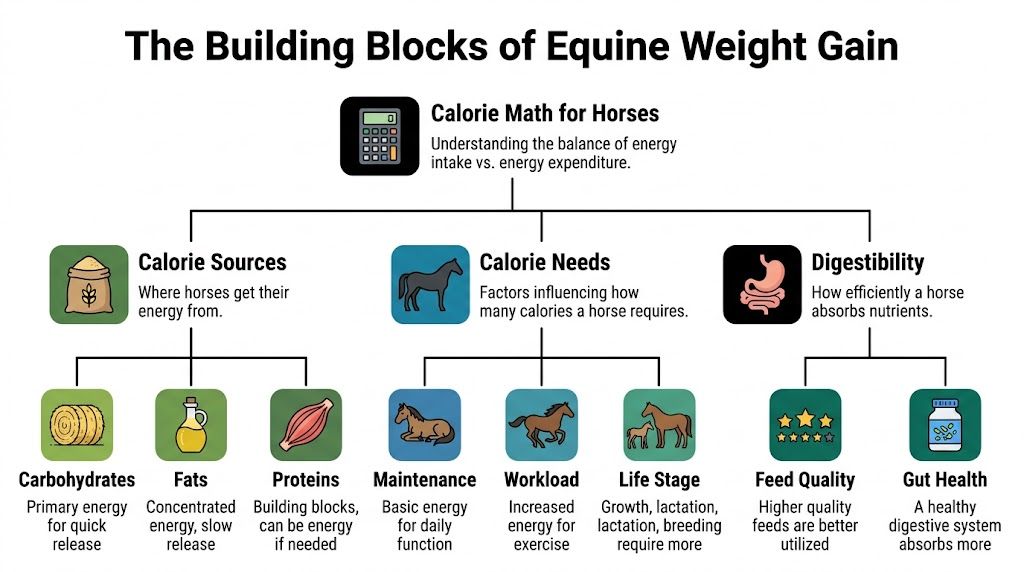
Weight gain is simple in theory and easy to get wrong in practice. Horses need more usable energy coming in than going out. The hard part is choosing calorie sources the digestive tract can handle.
Start with the base of the diet
Think of the diet as a pyramid. The wide base is forage. Above that sit digestible fiber sources such as beet pulp. Then come fats. At the top, if needed, are concentrates. Owners often reverse that order and jump straight to more grain. That’s where many feeding plans start to wobble.
Forage does more than provide calories. It keeps the gut working the way it should. A horse that has steady access to good hay or an appropriate forage replacement usually handles a weight gain program better than a horse getting large, starchy meals with an inconsistent forage base.
Digestible fiber matters because it adds calories without pushing the horse into the same metabolic pattern as a grain-heavy ration. It’s one reason beet pulp and alfalfa show up so often in successful programs for hard keepers.
Where fat and protein fit
Fat is the densest safe lever you can pull once the forage base is solid. According to Platinum Performance on weight gain for horses, fats provide 9 kcal/g compared with 4 kcal/g for carbohydrates. The same source notes that adding ½ to 1 cup of oil daily can supply 1,800 to 3,600 kcal, roughly equivalent to 4 to 8 lbs of hay, and that commercial feeds with 13% fat have shown 20% to 30% better nutrient absorption through enhanced fiber digestion.
That sounds attractive, and it is, but fat isn’t a complete answer by itself. Calories can cover ribs. They don’t automatically build a stronger topline or useful tissue. For that, the horse also needs quality protein from ingredients such as alfalfa or soybean meal.
Here’s the practical hierarchy I use when thinking through the best horse feed for weight gain:
- Forage first: fix quantity, quality, and access.
- Add digestible fiber: beet pulp is a common next step.
- Use fat for density: oil, rice bran, or a high-fat commercial feed.
- Check protein quality: especially in horses that look thin and weak over the back.
- Use grain carefully: only when needed, and not as the main rescue plan.
Feeding more calories is only half the job. The horse also has to absorb them, and the body has to have the right raw materials to turn them into useful condition.
If you’re used to thinking about digestion support across animals, the logic is familiar. Better nutrient use matters as much as what goes into the bucket. That’s the same reason owners often look into products like the best probiotic for cats when gut efficiency is part of the problem.
A Guide to High-Calorie Feed Categories
Walk into a feed store and you’ll see many paths to the same label claim. Some are sensible. Some are too starchy for the horse in front of you. Some are perfect for a senior and awkward for a young horse with good teeth and free-choice hay. The category matters more than the marketing language on the bag.
Forage and super fibers
The first category is still the most important. Horses gain more safely when the program begins with forage.
Alfalfa earns a place here because it brings both calories and protein. For a thin horse that’s already eating grass hay, replacing part of that forage with alfalfa often improves the diet more cleanly than adding a lot of grain. Mad Barn’s weight gain guidance notes that alfalfa can provide up to 20% more energy than grass hay.
Beet pulp is the classic super fiber. For an average 1100 lb horse, adding 2 to 3 lbs daily provides a meaningful calorie boost from highly digestible fiber, and it does so with very low starch. The same Mad Barn resource lists beet pulp at about 2.23 Mcal/kg of digestible energy with 1.3% starch. That combination is why it’s so useful when you want more calories without the baggage of a grain-heavy increase.
Fats, concentrates, and complete feeds
The next group includes oils, stabilized rice bran, and high-fat commercial concentrates. These work well when forage and digestible fiber aren’t enough by themselves.
Oils are compact and effective, but they’re easy to overdo if you add them too fast or use them to replace needed protein and fiber. Rice bran is often easier for owners who prefer something bagged and scoopable. High-fat commercial feeds can be especially helpful when the tag shows a thoughtful formula rather than just a flashy weight gain claim.
Then there are complete feeds, which deserve special mention for seniors and horses with poor chewing. A horse that can’t process long-stem hay may look like a hard keeper when hay is no longer an efficient calorie source for that individual. In those cases, a complete senior feed can act as both concentrate and forage replacement.
Good feed choice starts with one question. Is this horse failing to get enough calories in, or failing to chew and use the calories already offered?
Comparing High-Calorie Feed Options
| Feed Type | Calories (Approx. Mcal/lb) | Key Benefit | Best For |
|---|---|---|---|
| Beet pulp | Qualitatively high for a fiber feed | Highly digestible fiber with low starch | Hard keepers needing safer calorie support |
| Alfalfa hay or cubes | Qualitatively higher than many grass hays | Adds energy plus useful protein | Horses needing a stronger forage base |
| Stabilized rice bran | Qualitatively calorie-dense | Fat and fiber in an easy-to-feed form | Horses needing more calories without large grain meals |
| Vegetable oil or flax oil | Very calorie-dense | Small volume adds substantial energy | Horses tolerating gradual fat introduction |
| High-fat commercial feed | Varies by product | Balanced, convenient calorie source | Performance horses or barns wanting an all-in-one option |
| Complete senior feed | Varies by product | Helps horses that can’t chew hay well | Senior horses or those with dental compromise |
A few buying notes matter more than brand loyalty:
- Read the tag for purpose: choose a feed meant for weight gain, senior support, or high-fat performance use.
- Check starch sensibly: many thin horses do worse on big starch increases.
- Look at the whole ration: a great concentrate can’t rescue poor forage management.
- Match form to the horse: pellets, cubes, soaked feeds, and shreds all have practical pros and cons.
What usually doesn’t work is throwing more sweet feed at a horse whose mouth hurts, whose hay is poor, or whose diet lacks quality protein.
Building Your Horse’s New Feeding Plan
Once the horse has been checked and you know what category of feed fits, build the plan like a ration, not a rescue mission.
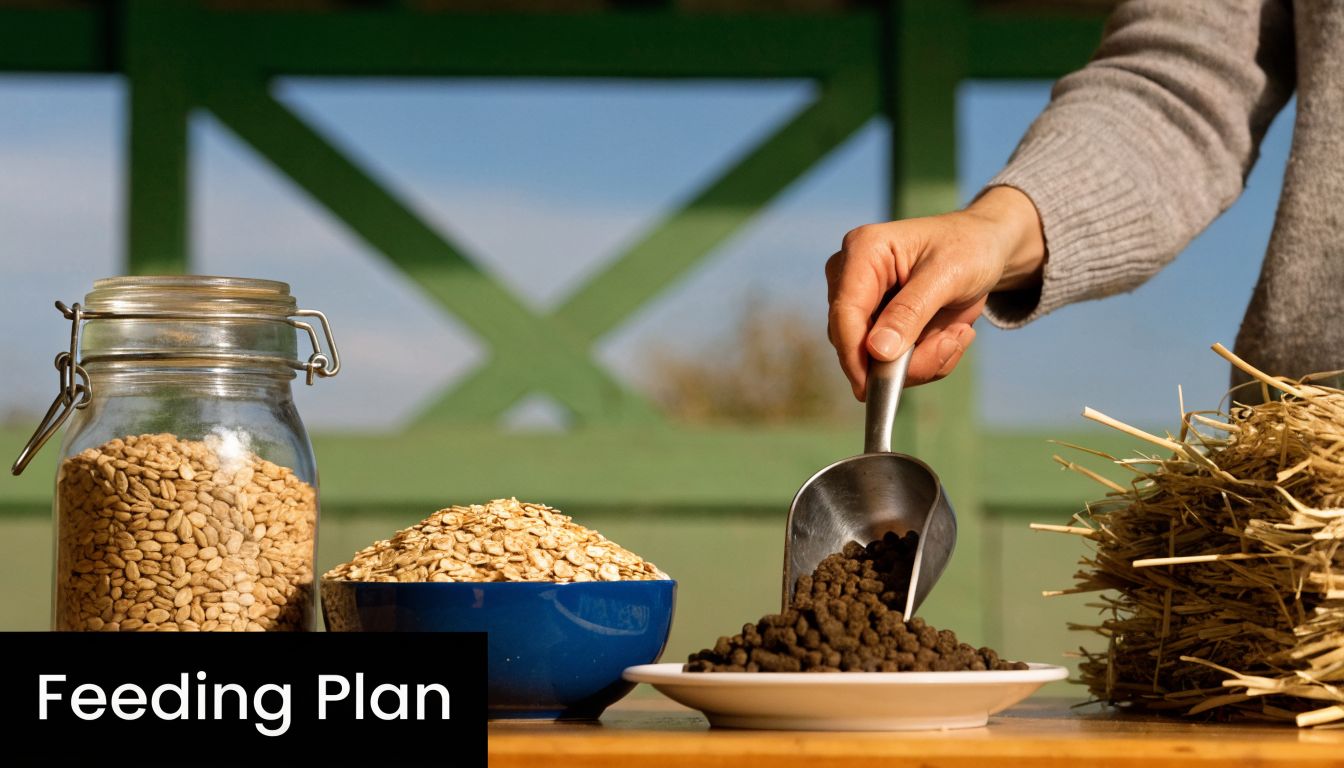
The horses that gain well usually do so on boring consistency. Same meal timing. Same measured amounts. Same slow transitions. Big swings in the bucket are where owners create setbacks.
Use a slow transition
Any new feed should come in gradually. That includes beet pulp, oils, rice bran, senior feed, and concentrates. The gut adapts best when you make changes in small steps over 7 to 14 days. If the horse is very thin, that doesn’t justify rushing. It makes caution more important.
A straightforward approach looks like this:
- Days 1 to 3: add a small portion of the new feed to the existing ration.
- Days 4 to 7: increase again if manure, appetite, and attitude stay normal.
- Days 8 to 14: continue stepping up toward the target amount.
- At any sign of trouble: hold steady or back down and reassess.
Many owners inadvertently sabotage a good plan. They see a high-calorie feed, assume more is better, and jump to a full portion in a day or two. Horses don’t reward impatience.
Guidance from Horse & Rider on feeding for weight gain is useful here. Fiber-based feeds like beet pulp and alfalfa create a “cooler” metabolic response than grain-based calories and help reduce colic risk. The same source also stresses that weight gain without enough protein from sources like soybean meal or alfalfa leads to fat accumulation rather than muscle development. It also notes that a controlled-starch, high-fat commercial feed, such as one with 13% fat, can help address energy, digestibility, and protein balance together.
A simple daily structure that works
The most reliable feeding plans split calories into multiple meals and keep forage available as much as possible.
A practical framework:
- Base ration: the best forage the horse can chew and consume consistently
- Added fiber: a measured serving of beet pulp or another digestible fiber source
- Protein support: alfalfa or a feed with quality protein sources
- Energy density: oil, rice bran, or a high-fat commercial concentrate
- Meal timing: divide concentrates and supplements into smaller feedings instead of one heavy meal
One example from the verified guidance is Purina’s gradual strategy of 2 lbs Strategy adding 3000 kcal plus 2 lbs alfalfa adding 1800 kcal, used in underweight horses as part of a measured gain plan in the earlier cited Mad Barn summary. The point isn’t that every horse needs that exact combination. The point is that successful plans are measured and deliberate.
This video gives a helpful visual overview of handling and preparing feed changes safely.
If you’re building a ration for a senior, keep texture and chewability front of mind. If you’re feeding a horse in work, keep muscle support in mind. If you’re feeding a rescue, keep gut tolerance ahead of ambition.
Monitoring Progress and Avoiding Pitfalls
A feeding plan isn’t finished when the scoop is set. You need feedback from the horse’s body.
Track the horse, not just the feed tub
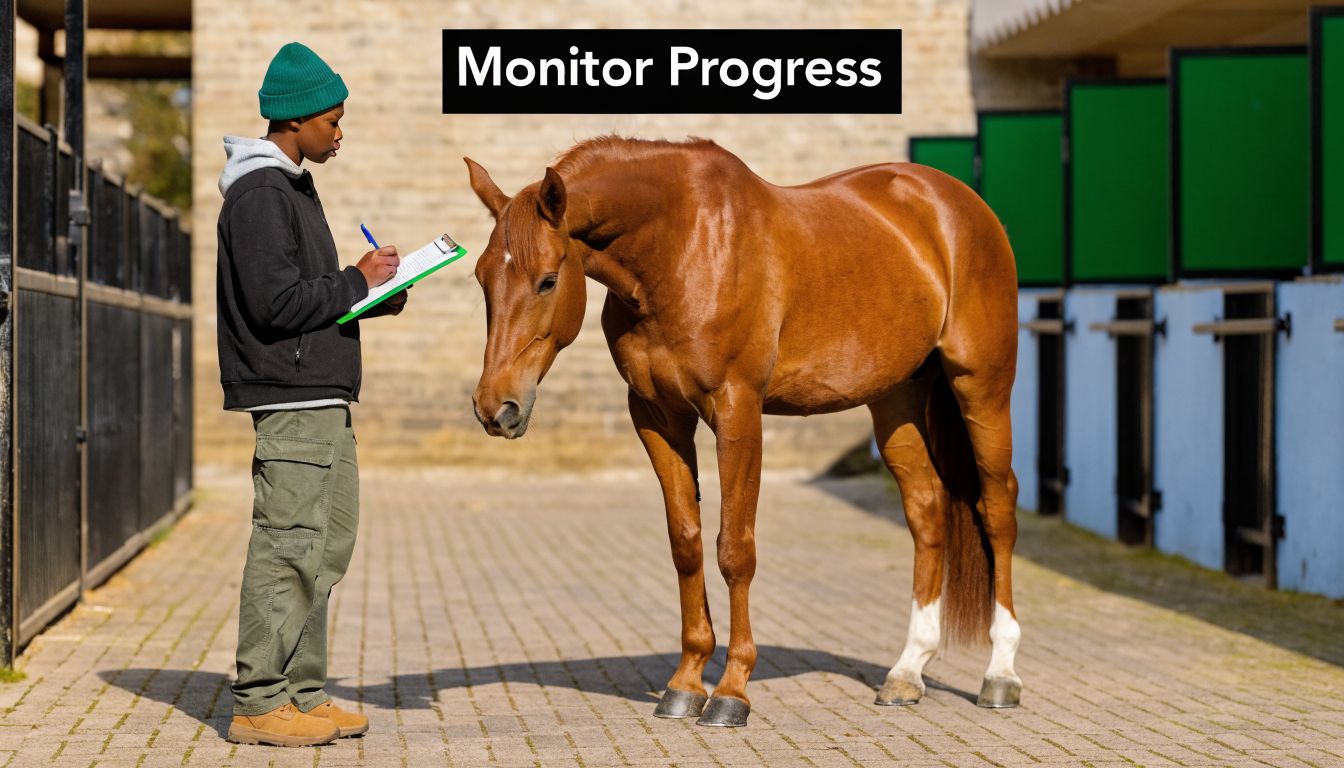
Use two tools consistently. First, body condition scoring. Second, a weight tape. Neither is perfect alone, but together they help you notice whether the horse is improving or just changing shape in one area.
Body condition scoring helps you look beyond emotion. Run your hands over the ribs, topline, withers, shoulder, and tailhead. A horse can appear better from one angle and still lack real progress through the back and hindquarters. Write the observations down. Photos from the same angle every few weeks help too.
A notebook matters more than people think. Once owners rely on memory, small changes get exaggerated or missed.
Keep records on paper. Feed amounts, turnout, manure, appetite, and body condition often explain a stall before the horse ever needs a different product.
If you’ve ever tracked age-related weight loss in other pets, the discipline is similar. This guide on what to feed an older cat that is losing weight reflects the same principle. Monitor the body, the appetite, and the ability to use food, not just what goes into the bowl.
Common mistakes that stall progress
A few problems show up again and again:
- Too much grain too quickly: this can create digestive upset and doesn’t solve poor forage use.
- Ignoring hay quality: no concentrate can fully compensate for weak forage management.
- Chasing calories without protein: the horse may soften but not improve in topline.
- Changing several things at once: that makes it hard to know what helped.
- Expecting instant transformation: some horses improve steadily, not dramatically.
Another common mistake is forgetting that needs change. Cold weather, more work, less turnout, poor pasture, or dental decline in an aging horse can all alter the ration that used to work. The best horse feed for weight gain may be different this winter than it was last spring.
Sample Meal Plans for Different Horses
These are practical models, not prescriptions. They show how different horses may need different versions of a successful plan.
Performance horse in regular work
This horse often needs more than hay alone can provide. A sensible setup is quality hay as the base, added alfalfa for extra energy and protein, a beet pulp meal for digestible fiber, and a high-fat commercial feed split across small meals. If the horse tolerates it well, a modest amount of oil or rice bran can increase calorie density without relying on heavy grain feeding.
Senior horse with chewing trouble
Many owners get the best results from a complete senior feed used as a forage replacement, usually soaked if needed for ease of chewing. Add alfalfa in a form the horse can manage, or use it only if dentition allows. Keep meals frequent and moderate. If extra calories are still needed, add a fat source slowly rather than piling on more traditional grain.
Thin rescue horse starting rehabilitation
Start with veterinary guidance, plain forage the horse can tolerate, and small, steady meals. If the horse adapts well, add beet pulp and then a controlled-starch, high-fat feed in measured steps. Rescue horses often tempt owners to overfeed from kindness. The better approach is patience, consistency, and watching manure, appetite, comfort, and body condition before each increase.
The strongest plans don’t look dramatic in the feed room. They look repeatable.
If you want more practical pet care guides written for real owners, visit MyPetGuider.com. It’s a useful place to find step-by-step help on feeding, health basics, and everyday care decisions across horses and other companion animals.
Leave a Comment