


The most popular advice about balanced homemade dog food recipes is also the most misleading: “just use fresh ingredients.” Fresh matters, but fresh alone doesn’t make a diet complete. A bowl of chicken, rice, and vegetables can look wholesome and still miss nutrients a dog needs every day.
That’s the real dividing line. You’re not just cooking for your dog. You’re formulating a diet. Once owners understand that difference, homemade feeding becomes much safer, more flexible, and far more useful for dogs with sensitive skin, digestive trouble, or ingredient intolerance.
A good homemade diet can be excellent. A casual one can create problems slowly, then all at once. The method below is the part most online recipes skip.
Table of Contents
- The Homemade Food Promise and Its Hidden Peril
- The Building Blocks of a Truly Balanced Bowl
- Crafting Your Dog's Core Recipe Template
- Smart Ingredient Swaps and Customization
- Why Supplements Are Non-Negotiable
- Portioning, Storage, and Kitchen Safety
The Homemade Food Promise and Its Hidden Peril
Owners usually come to homemade feeding for good reasons. They want fewer mystery ingredients, better control, and meals that feel more aligned with their dog’s needs. That instinct is understandable, and in the right hands, it can work very well.
The problem is that homemade diets are often judged by appearance instead of nutrient balance. A glossy bowl says nothing about calcium, trace minerals, essential fatty acids, or whether the recipe can safely support a dog for months instead of days.
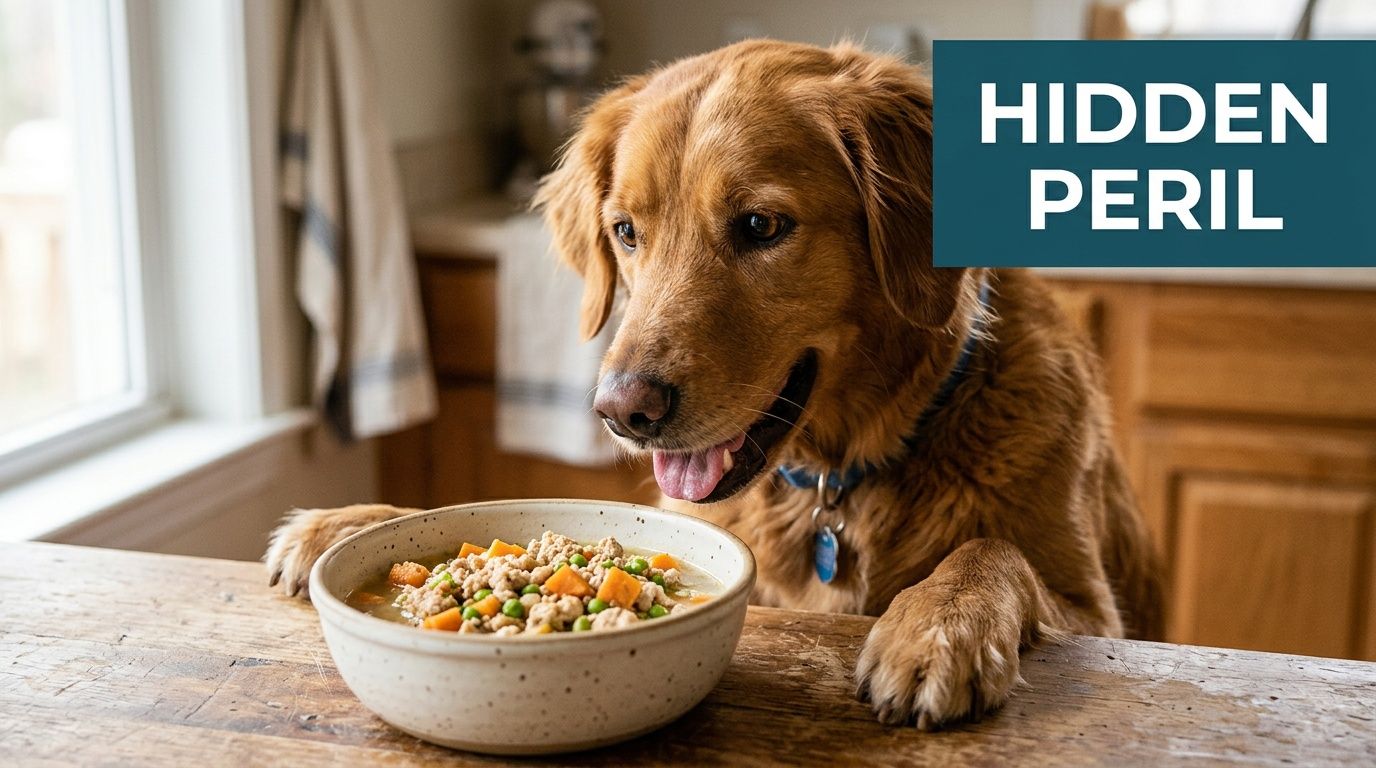
There’s strong reason to take balanced homemade food seriously. A 2024 study of 104 dogs on personalized, balanced homemade diets found nearly complete remission of symptoms in pathological cases, with owner satisfaction for dogs with skin and gastrointestinal issues rising to almost 100%. That’s the upside when the diet is designed properly.
Homemade helps only when balance comes first
That same promise is why sloppy recipes are so risky. Owners often copy what looks healthy to them, then feed it daily as if repetition makes it complete. It doesn’t.
Practical rule: A homemade meal can be nourishing. A homemade diet has to be complete over time.
This matters even more if you’re tempted by raw feeding shortcuts or internet claims that “natural” means safer. Raw ingredients bring a separate layer of pathogen risk, which is one reason I urge owners to understand food safety before changing course. If you’re weighing that option, review this guide on whether dogs can eat raw chicken breast.
The real job is formulation
Balanced homemade dog food recipes work best when you think like a planner, not just a cook. That means choosing ingredients for a purpose, preparing them safely, and filling the nutrient gaps that whole foods alone usually leave behind.
A dog with itchy skin may improve on a homemade diet because the recipe is customized, consistent, and digestible. A different dog may worsen on a homemade diet because the owner removed a trigger ingredient but also removed key nutrients without realizing it.
That’s why the right question isn’t “Which homemade recipe is best?” It’s “How do I build a recipe that stays balanced even when ingredients change?”
The Building Blocks of a Truly Balanced Bowl
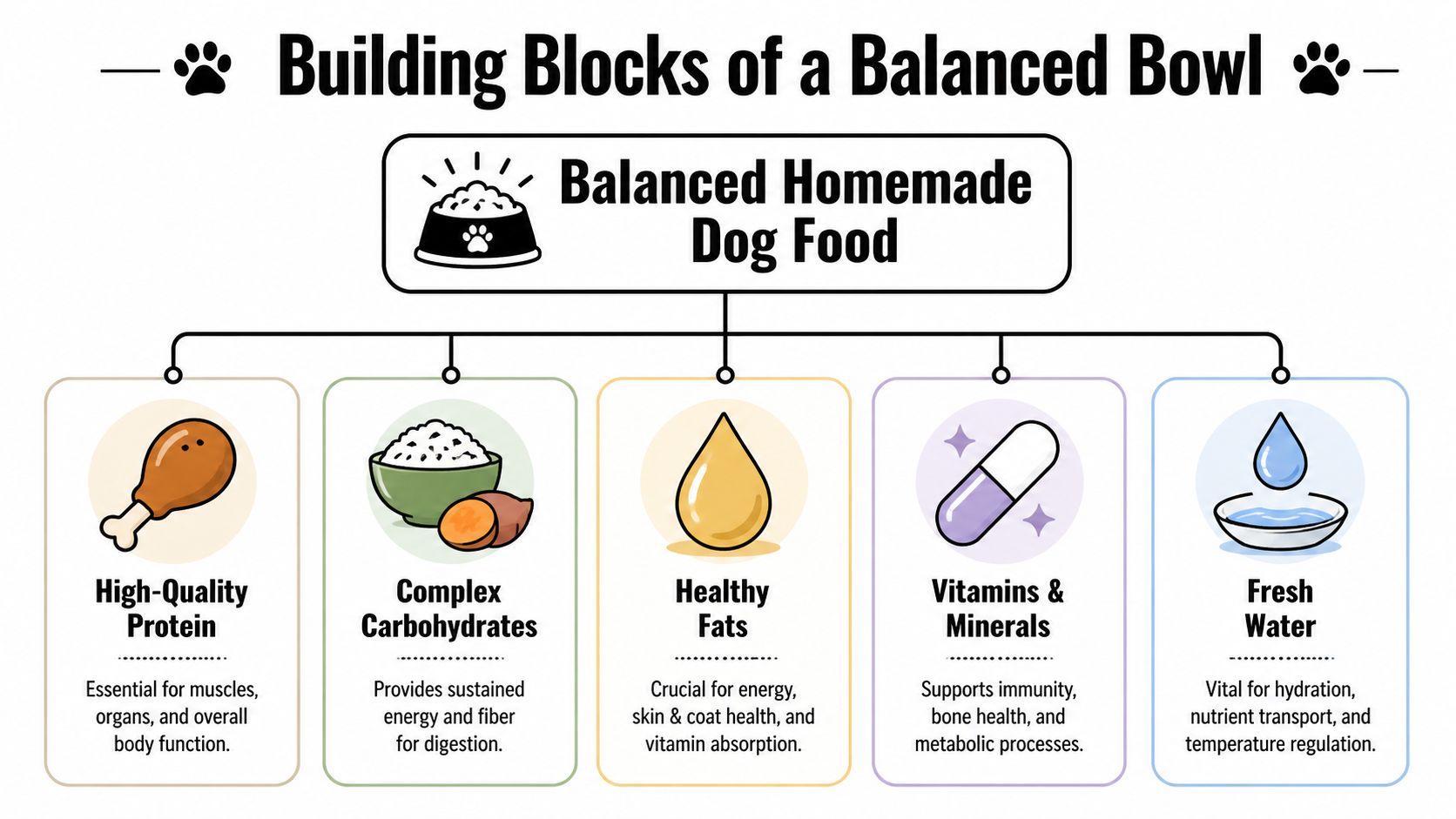
Most failed homemade diets have the same look: meat, a starch, and a vegetable. That’s a meal pattern, not a nutritional system. Dogs need a bowl built from macronutrients, micronutrients, hydration, and correct proportions.
The caution here isn’t theoretical. A 2013 UC Davis review of 200 homemade dog food recipes found that 95% lacked at least one essential nutrient and 84% had multiple deficiencies. That’s why balanced homemade dog food recipes should start with structure, not inspiration.
Protein is the anchor, not the whole diet
Protein supports muscle, tissue repair, organ function, and immune health. Lean poultry, beef, pork, fish, and eggs can all fit, depending on the dog and the recipe.
But protein isn’t enough by itself. Muscle meat is especially weak as a stand-alone plan because it doesn’t automatically cover the mineral side of the diet. Owners often overfocus on “good meat” and underfocus on what that meat lacks.
Fats do more than add calories
Healthy fats carry energy and help support skin, coat, and absorption of fat-soluble nutrients. In kitchen terms, fish oil and other controlled fat sources prove useful.
If a dog’s coat is dry or the recipe is very lean, fat balance needs attention. Too much can upset stools. Too little leaves the diet flat, both nutritionally and in palatability.
Carbohydrates are a tool, not a requirement in every bowl
Carbs aren’t automatically bad, and they aren’t mandatory in the same way supplements are. In practice, digestible carbohydrate sources can help with stool quality, energy delivery, and recipe consistency.
Useful options often include cooked rice, potato, or other well-tolerated starches. The key is that carbs should serve the dog, not pad the bowl.
A balanced bowl isn’t built by avoiding one ingredient category. It’s built by knowing what each category contributes.
Vegetables and micronutrients need their own plan
Vegetables can add fiber, moisture, and useful phytonutrients. They do not magically complete a recipe. A handful of spinach or carrots doesn’t solve calcium, iodine, zinc, copper, or vitamin shortfalls.
Think of AAFCO standards as a checklist for nutritional adequacy, not a brand label reserved for packaged food. If you cook at home, the standards still matter. They tell you what the diet has to deliver, even if the food comes from your stove.
Water still belongs in the framework
Owners rarely think of fresh water as part of recipe design, but it is. Homemade diets often contain more moisture than dry food, which can help some dogs, yet that doesn’t replace free access to water.
Here’s the simplest way to remember the bowl:
- Protein foundation: Use it to anchor the recipe, not dominate it.
- Fat support: Add enough for skin, coat, energy, and nutrient absorption.
- Carb choice: Use digestible carbs when they help the individual dog.
- Micronutrient completion: Homemade diets most often fail in this area.
- Water access: Keep hydration constant, even with moist food.
Crafting Your Dog's Core Recipe Template
Static recipes are where many owners get stuck. They copy one batch for one “medium dog,” then try to stretch it across different breeds, activity levels, and sensitivities. A better approach is to build from a repeatable template.
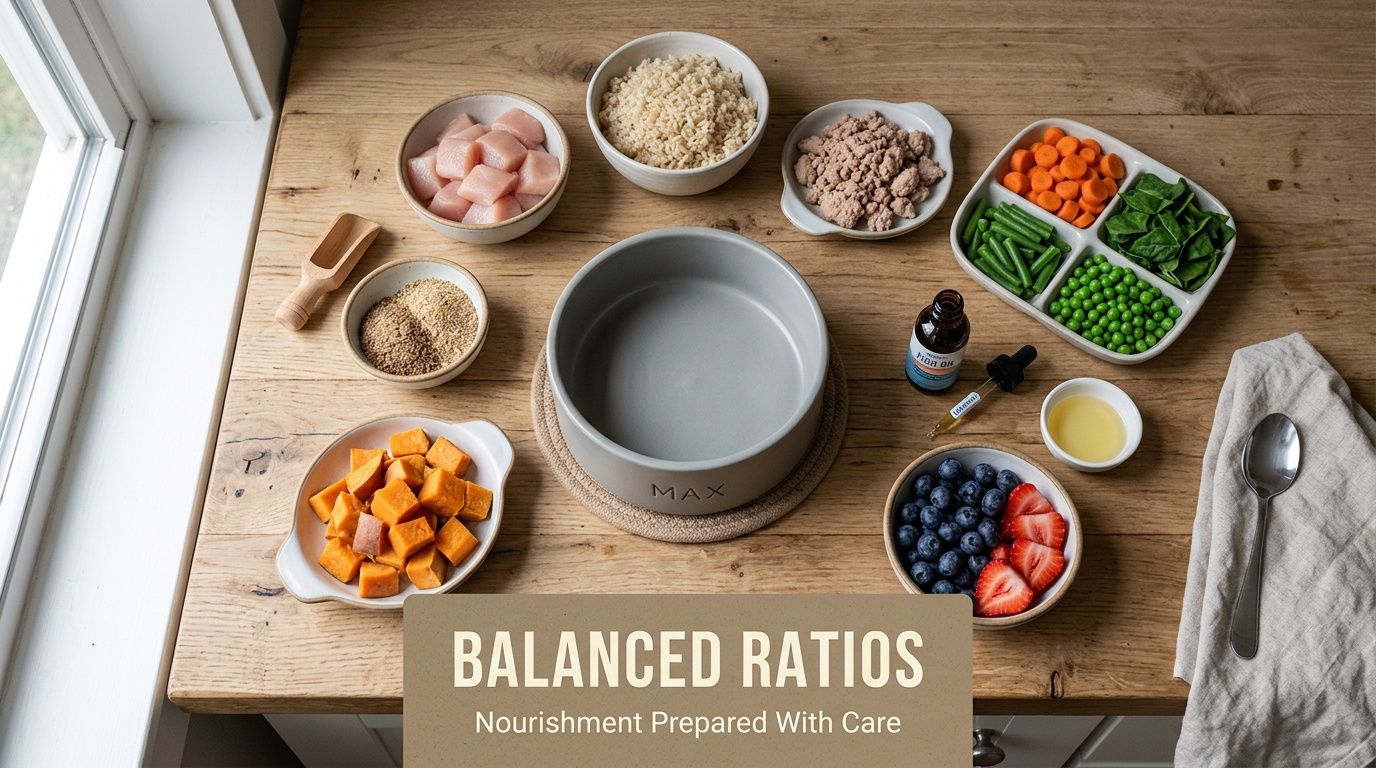
Veterinary nutritionists recommend a framework of 40 to 50% protein, 25 to 30% vegetables and fruits, and 10 to 20% carbs. The same guidance notes that proteins should be cooked to 165°F, and lightly steaming vegetables retains 80 to 90% of their vitamins.
Start with ratios, not a fixed recipe
The biggest shift is mental. Don’t ask, “How much turkey and rice goes into the recipe?” Ask, “What proportion of this batch is protein, what portion is plant matter, and where are the missing nutrients being replaced?”
That ratio-based thinking is what makes customization possible. It’s also what prevents the common slide into “I ran out of one ingredient, so I doubled another.”
A practical bowl usually starts with:
- A primary cooked protein such as turkey, chicken, lean beef, pork, or cooked fish.
- A vegetable mix chosen for digestibility and tolerance.
- An optional carb source if the dog does well with it.
- Targeted additions that complete the bowl rather than just bulk it up.
If you’re transitioning slowly and wondering how home-prepared food fits with an existing diet, this guide on mixing two different dog foods can help you think through the practical side.
Cook and assemble the batch correctly
Technique matters more than many owners realize. Under-cooked meat raises safety concerns. Overcooked vegetables can turn into mush with less nutritional value and poor texture.
Use this kitchen sequence:
- Cook proteins fully: Bring meat to 165°F so the protein is safe to serve.
- Steam vegetables lightly: This helps preserve texture and a substantial share of vitamins.
- Cook carbs plainly: No onions, garlic, rich broths, or heavy seasoning.
- Cool before mixing: This protects heat-sensitive additions and makes portioning easier.
Don’t season dog food the way you season family food. The safest homemade dog meals are usually the plainest ones.
A practical base template
Use this as a method, not a forever recipe:
| Bowl component | What to include |
|---|---|
| 40 to 50% protein | Cooked lean turkey, chicken, beef, pork, fish, or a combination your dog tolerates |
| 25 to 30% vegetables or fruits | Lightly steamed pumpkin, green beans, carrots, kale, berries, or similar dog-safe produce |
| 10 to 20% carbs | Cooked rice or another digestible starch if your dog benefits from it |
| Essential add-ins | Calcium source, omega-3 support, and a canine-specific balancing supplement |
| Water and texture | Add moisture as needed for mixing and palatability |
This template is deliberately plain because plain is easier to keep consistent. Dogs with stomach sensitivity usually do better when owners change one variable at a time.
A few practical notes make a big difference:
- Choose lean cuts first: It’s easier to add controlled fat than to correct a greasy batch.
- Use repeated ingredients during trials: If you’re evaluating skin or GI response, novelty makes patterns harder to read.
- Write the batch down: Ingredient drift is one of the quietest ways a good recipe becomes an imbalanced one.
Balanced homemade dog food recipes become sustainable when the method stays stable, even if the ingredients rotate inside the same framework.
Smart Ingredient Swaps and Customization
Customization is where homemade feeding becomes useful. It’s also where owners accidentally break a good recipe. A safe swap doesn’t just replace calories. It has to preserve the job that ingredient was doing in the bowl.
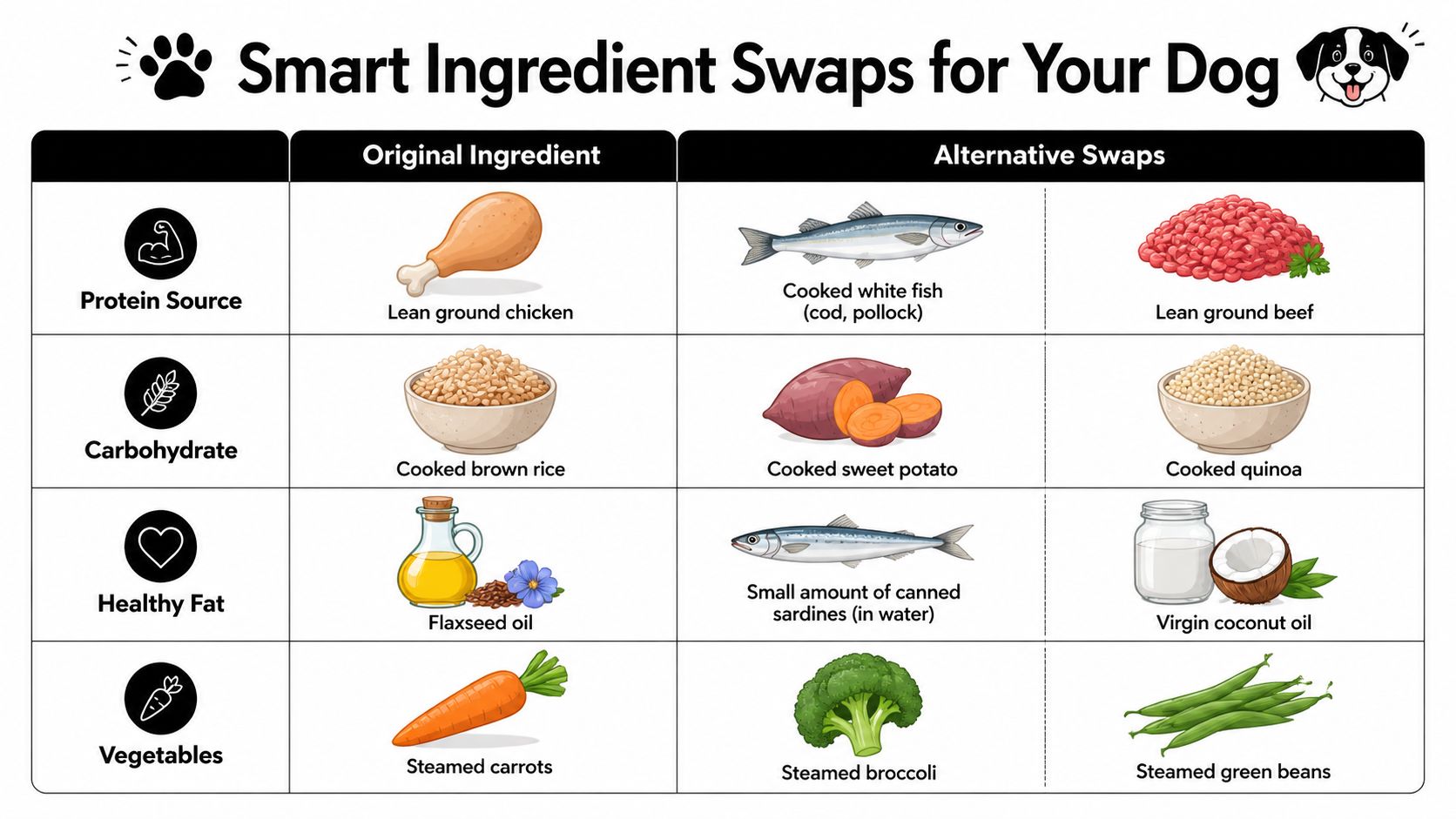
A key example is fiber. When making changes for allergies or cost, simply removing grains without replacing fiber properly can lead to gastrointestinal issues, a problem noted in 40% of homemade allergy recipes. That’s why balanced homemade dog food recipes need rules for substitution.
Swap proteins carefully
Protein swaps are the most common. They’re also the easiest to oversimplify.
Chicken to turkey is usually a straightforward kitchen change because the role in the recipe stays similar. Chicken to a fattier red meat is different. Now you may be shifting energy density, stool quality, and how much added oil the recipe still needs.
Use this comparison mindset:
- Lean poultry to lean poultry: Usually the simplest substitution.
- Poultry to fish: Helpful for some dogs, but the fat profile and texture change.
- Poultry to beef or pork: Works for many dogs, but watch richness and tolerance.
Adjust vegetables and carbs without breaking the recipe
Vegetable swaps should focus on digestibility, not just color or what’s left in the fridge. Pumpkin, green beans, and carrots often behave predictably. Very fibrous greens may need more caution in sensitive dogs.
For dog-safe leafy options, this overview of whether dogs can eat collard greens is useful when you’re deciding if a vegetable belongs in rotation.
Carb swaps should answer a practical question: what is this ingredient doing here? If rice helps stool consistency and easy digestion, replacing it with a trendier starch may not improve anything. If the dog doesn’t need a carb-heavy bowl, lowering that portion can make sense, but only if the rest of the recipe remains balanced.
A good swap preserves function. It doesn’t just preserve the look of the bowl.
When a swap means you should pause and ask for help
Some changes look minor and aren’t. If you’re dealing with a puppy, a senior dog, chronic GI signs, recurrent skin flare-ups, or a dog already on a restricted ingredient plan, the recipe stops being a casual home project.
Pause before making major changes when:
- Symptoms are the goal: Allergy and GI diets need tighter control than maintenance diets.
- You’re removing multiple ingredients at once: That makes the response impossible to interpret.
- You’re replacing supplements with food guesses: That’s where many “natural” diets drift into deficiency.
Budget swaps can be smart. Seasonal vegetables, different cuts of the same protein, and simple batch planning all help. The rule is that savings can come from ingredient selection, not from abandoning the balancing structure.
Why Supplements Are Non-Negotiable
Most homemade diet failures don’t happen because the owner chose the wrong meat. They happen because the owner assumed whole foods would cover everything.
That assumption is persistent and dangerous. A benchmark vet-approved recipe includes supplements such as fish oil for omega-3s and eggshell powder for calcium. The same source notes that 83% of amateur recipes are imbalanced, and that a lack of omegas can lead to dermatitis in 60% of cases.
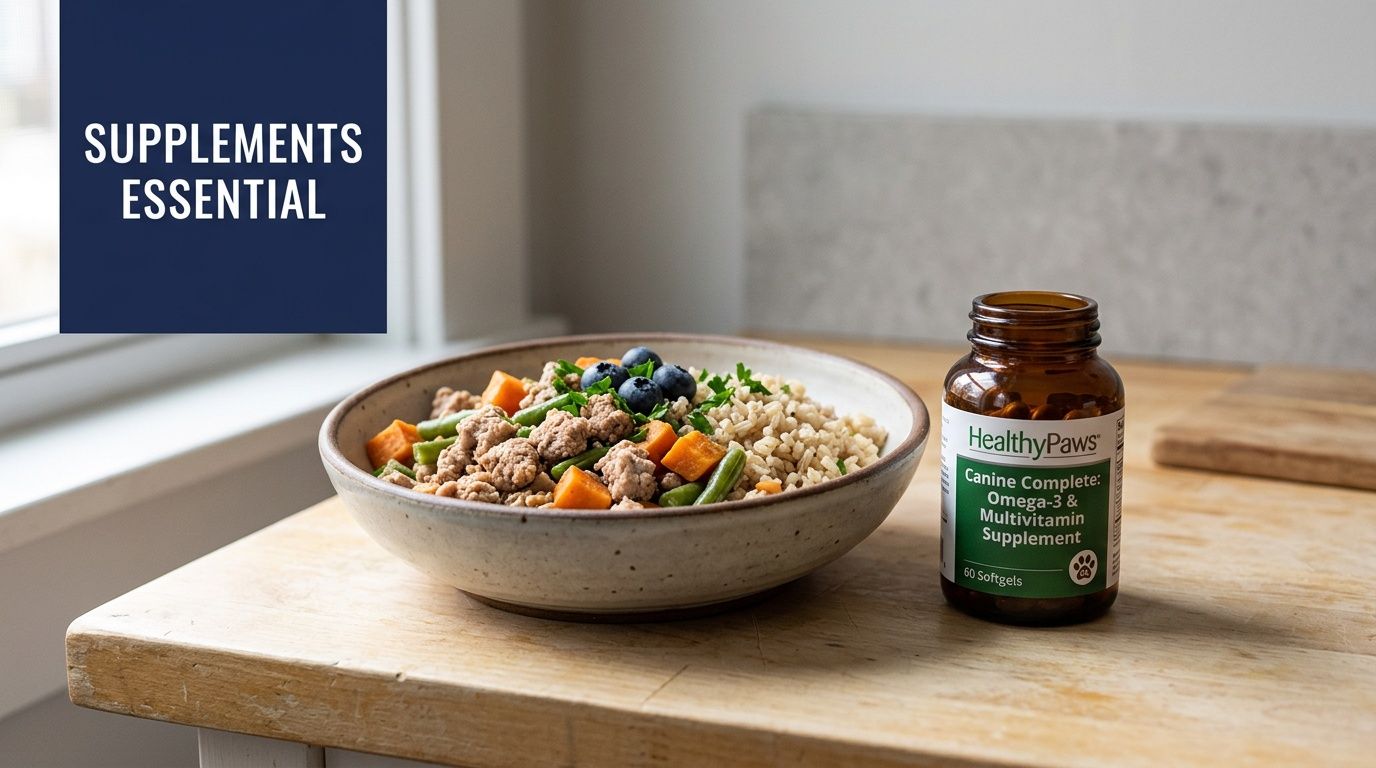
Whole foods are not enough by themselves
Muscle meat brings protein and phosphorus. It does not automatically bring enough calcium. Vegetables offer useful plant nutrients. They do not reliably complete trace mineral needs. Even thoughtful recipes often drift low in the exact areas dogs need every day for long-term stability.
This is why “I feed fresh whole foods” and “I feed a complete diet” are not the same statement.
The most dangerous homemade recipe is often the one that looks healthiest to the owner.
What usually needs to be added
For most home-prepared diets, the essential support falls into a few categories:
- Calcium source: Often eggshell powder or a canine calcium supplement, because meat alone won’t balance the mineral side of the recipe.
- Omega-3 support: Fish oil is commonly used to support skin and coat health.
- Canine vitamin and mineral balancer: A product designed for homemade diets helps close the nutrient gaps food ingredients don’t consistently cover.
Tools such as Balance IT are useful because they move owners away from guesswork. That matters. Measuring a teaspoon of a purpose-built supplement is safer than trying to “cover the bases” with random extras from the pantry.
There’s also a practical discipline here. Once a supplement plan works, keep it stable. Don’t rotate in and out based on mood, supply, or social media advice. Supplements in homemade dog food are not garnish. They are part of the formula.
Portioning, Storage, and Kitchen Safety
A balanced recipe can still fail in real life if the portion is wrong, the batch sits too long in the fridge, or the kitchen routine allows contamination. This is the part owners often underestimate because it feels less nutritional and more logistical.
That’s a mistake. Most online guides don’t give good portion math, even though daily caloric needs can vary by 50% between breeds, and cooked meals carry bacterial risk, with USDA-aligned guidance suggesting no more than 3 to 5 days of refrigeration.
A simple way to estimate daily portions
For an adult dog on a maintenance diet, a practical starting point is the feeding guide below, based on 2% of body weight per day. It’s a starting estimate, not a final prescription. Activity, age, body condition, and health status all matter.
| Dog's Weight (lbs) | Approx. Daily Portion (grams) | Approx. Daily Portion (cups) |
|---|---|---|
| 10 | 90 | about 3/4 cup |
| 20 | 180 | about 1 1/2 cups |
| 30 | 270 | about 2 1/4 cups |
| 40 | 360 | about 3 cups |
| 50 | 450 | about 3 3/4 cups |
| 60 | 540 | about 4 1/2 cups |
| 70 | 635 | about 5 1/4 cups |
| 80 | 725 | about 6 cups |
Use the table as a launch point, then watch the dog, not just the bowl.
Signs the portion needs adjusting include:
- Weight creeping up: Trim the daily amount modestly and reassess body condition.
- Persistent hunger with weight loss: Review the calorie density and the dog’s activity.
- Soft stool after larger meals: Split the daily amount into smaller feedings.
Safe storage matters as much as the recipe
Cooked homemade food is perishable. Once cooled, portion it promptly into clean containers.
Use these basic rules:
- Refrigerate short term: Keep refrigerated meals within the 3 to 5 day window.
- Freeze extra portions: Freeze batch extras early, not after several days in the fridge.
- Thaw safely: Thaw in the refrigerator, not on the counter.
- Label batches: Date each container so older meals get used first.
If the food smells off, has a changed texture, or sat out too long, discard it. Homemade dog food should be handled with the same care you’d use for cooked meat intended for your family.
Kitchen hazards to keep out of the bowl
Homemade feeding also means your kitchen ingredients become part of your dog’s risk profile. Keep these out of recipes and out of accidental reach:
- Onions and garlic: Common in human cooking, unsafe for dogs.
- Grapes and raisins: Never use them as mix-ins or snacks.
- Chocolate and xylitol-containing products: Keep far from prep areas.
- Rich sauces and heavy seasonings: They turn a plain dog meal into a risky one.
- Bones added casually after cooking: Don’t improvise with leftovers.
Batch cooking works best when the process is boring. Clean tools, plain ingredients, labeled portions, and repeatable handling habits keep homemade feeding sustainable.
If you want more practical pet-care guidance written for real life, visit MyPetGuider.com. It’s a useful place to compare everyday nutrition advice, feeding questions, safety topics, and step-by-step care tips that help you make calmer, smarter decisions for your dog.




Leave a Comment