


You may be noticing small things that feel bigger than they look. Your dog pauses before getting up. Walks end a little earlier. The coat seems duller, the stools less predictable, or your once sharply tuned companion seems a bit more restless at night. None of that means you’ve failed your dog. It means you’re paying attention.
That’s exactly where good senior care starts. Supplements can’t stop aging, but they can support comfort, mobility, digestion, and daily function when chosen thoughtfully. The key is not buying the product with the loudest label. It’s matching the supplement to the problem you’re seeing.
Table of Contents
- Your Senior Dog's Changing Needs
- The Core Supplement Categories Explained
- Joint Supplements for Improved Mobility
- Boosting Brain, Skin, and Gut Health
- How to Evaluate and Choose a Quality Supplement
- Dosing Safely and Avoiding Harmful Interactions
- Your Vet Consultation Checklist
Your Senior Dog's Changing Needs
A lot of owners first notice aging in ordinary moments. A dog who used to spring into the car now waits to be lifted. A favorite nap spot on the couch suddenly seems too high. A morning walk still happens, but the pace has changed.
Those quiet changes matter because senior dogs often don’t announce discomfort clearly. They adapt. They move differently, rest more, and ask for help in subtle ways. That’s why support often works best when you start paying attention early, not only when the problem becomes severe.

If you’re considering supplements, you’re in good company. In the Dog Aging Project, approximately 50% of all dogs received supplements, with omega-3 fatty acids and glucosamine the most common choices, and use was especially common in dogs with orthopedic issues, which affect over 20% of senior dogs by age 8 according to this Dog Aging Project discussion.
That doesn’t mean every senior dog needs a shelf full of products. It means many owners and veterinarians are using supplements as one part of a broader comfort plan. Good bedding, healthy body weight, regular exams, gentle exercise, and practical home changes all matter too. Some dogs also benefit from simple support tools at home, much like owners use routine aids described in guides to dog belly bands for everyday management.
What aging often looks like at home
You may see one issue. You may see several at once.
- Mobility changes like stiffness after rest, slower stairs, reluctance to jump, or shorter walks
- Cognitive changes such as pacing at night, staring, confusion with routines, or reduced engagement
- Digestive changes including more sensitive stools, gas, variable appetite, or trouble adjusting to food changes
- Skin and coat changes like dry skin, a dull coat, or increased flaking
Older dogs often look “fine” until you compare them to how they moved and behaved six months ago.
That’s why the best supplements for senior dogs aren’t a universal list. They’re a decision based on what your dog’s body is asking for right now.
The Core Supplement Categories Explained
Think of supplements as tools in a home toolbox. A hammer is useful, but not if the underlying problem needs a screwdriver. The same idea applies here. A joint supplement won’t fix every senior-dog issue, and a probiotic won’t help a painful hip.
A quick way to think about supplement jobs
Some categories support structure. Others support function.
Joint support helps the body’s “hinges” move with less friction.
Omega-3 fatty acids act more like internal lubrication and membrane support.
Probiotics and digestive enzymes help the gut process food more smoothly.
Cognitive support aims to help the aging brain stay steadier in daily routines.
Multivitamins can help fill nutritional gaps when intake is inconsistent or diets are limited.
The mistake I see most often is buying based on age alone. “Senior” tells you your dog is in a life stage. It doesn’t tell you what problem needs help.
Senior Dog Supplement Categories at a Glance
| Category | Primary Goal | Key Ingredients | Best For Dogs Showing… |
|---|---|---|---|
| Joint Support | Support cartilage and easier movement | Glucosamine, chondroitin, MSM | Stiffness, limping, trouble rising, hesitation on stairs |
| Omega-3 Fatty Acids | Support inflammation balance, skin, and brain function | EPA, DHA from fish oil | Dry skin, dull coat, generalized stiffness, aging brain changes |
| Probiotics and Digestive Enzymes | Support gut balance and digestion | Probiotics, digestive enzyme blends | Gas, loose stools, sensitive digestion, inconsistent appetite |
| Cognitive Support | Support daily mental function | Brain-support formulas, targeted fatty acids, antioxidant blends | Night pacing, confusion, altered sleep-wake cycles |
| Multivitamins | Fill broad nutritional gaps | Mixed vitamins and minerals | Picky eating, restricted diets, dogs needing broad nutritional review |
How to use the table in real life
Start with the symptom that affects quality of life most.
If your dog is reluctant to stand after a nap, start by looking at joint support. If the biggest issue is dry skin and a dull coat, look first at omega-3 fatty acids. If stools are inconsistent and your dog seems uncomfortable after meals, digestive support may deserve attention before anything else.
Some dogs need more than one category, but don’t stack products automatically. Pick the most important target first, then give it enough time and monitoring to judge whether it’s helping.
Practical rule: Match the supplement to the symptom you can clearly describe to your veterinarian.
That one habit protects you from buying three “senior blends” that all do roughly the same thing.
Joint Supplements for Improved Mobility
Mobility is the reason many owners start searching for the best supplements for senior dogs. They’re not just trying to help their dog walk farther. They want their dog to get up without effort, settle comfortably, and enjoy normal routines again.

What joint supplements are trying to do
The simplest analogy is this. A healthy joint works like a well-padded door hinge. The cartilage acts like cushioning. Joint fluid helps movement stay smooth. With age, that system gets worn, thinner, and more irritated.
That’s where glucosamine and chondroitin come in. They’re commonly used to support cartilage and joint comfort. You’ll also see MSM in some formulas, usually included as part of broader joint support blends.
A product such as Nutramax Cosequin is a familiar example many veterinarians know well, which can be useful because your vet may already have experience with dosing style, ingredient profile, and expected response. What matters most isn’t the brand name by itself. It’s whether the formula fits your dog’s size, symptoms, and medical history.
What results owners can realistically expect
This is one of the few supplement areas where owners often notice day-to-day changes they can describe clearly. According to this review of senior dog supplements, joint supplements containing glucosamine and chondroitin can improve mobility in 70% of arthritic senior dogs within 4 to 6 weeks, and joint problems affect up to 80% of large-breed senior dogs by age 8.
That doesn’t mean the effect is dramatic in every dog. Some dogs move more freely. Some hesitate less on stairs. Some seem brighter because moving hurts less. Improvement may look modest from across the room but meaningful in your dog’s daily comfort.
Here’s a useful way to judge response:
- Watch getting up from a lying position
- Notice first steps after rest
- Track stairs and car entry
- Measure walk enthusiasm, not just distance
- Record bad days and better days in a notebook
Later in the visit, this short video gives a helpful visual sense of senior-dog mobility support in practice.
Signs joint support may fit your dog
Joint supplements are worth discussing with your vet if your dog:
- Takes longer to stand up after naps
- Moves stiffly at the start of walks
- Avoids slick floors or seems unsure of footing
- Stops jumping onto furniture they previously used
- Lags behind on walks despite still wanting to go
When a joint supplement helps, owners often say, “I didn’t realize how much he was compensating.”
That’s the right way to think about it. You’re not trying to create a younger dog. You’re trying to remove some of the friction from an older body.
Boosting Brain, Skin, and Gut Health
Not every aging change starts in the joints. Some owners come in because the coat has lost shine, the dog seems mentally “off,” or stools have become inconsistent. Those signs can look unrelated, but they often belong in the same conversation.
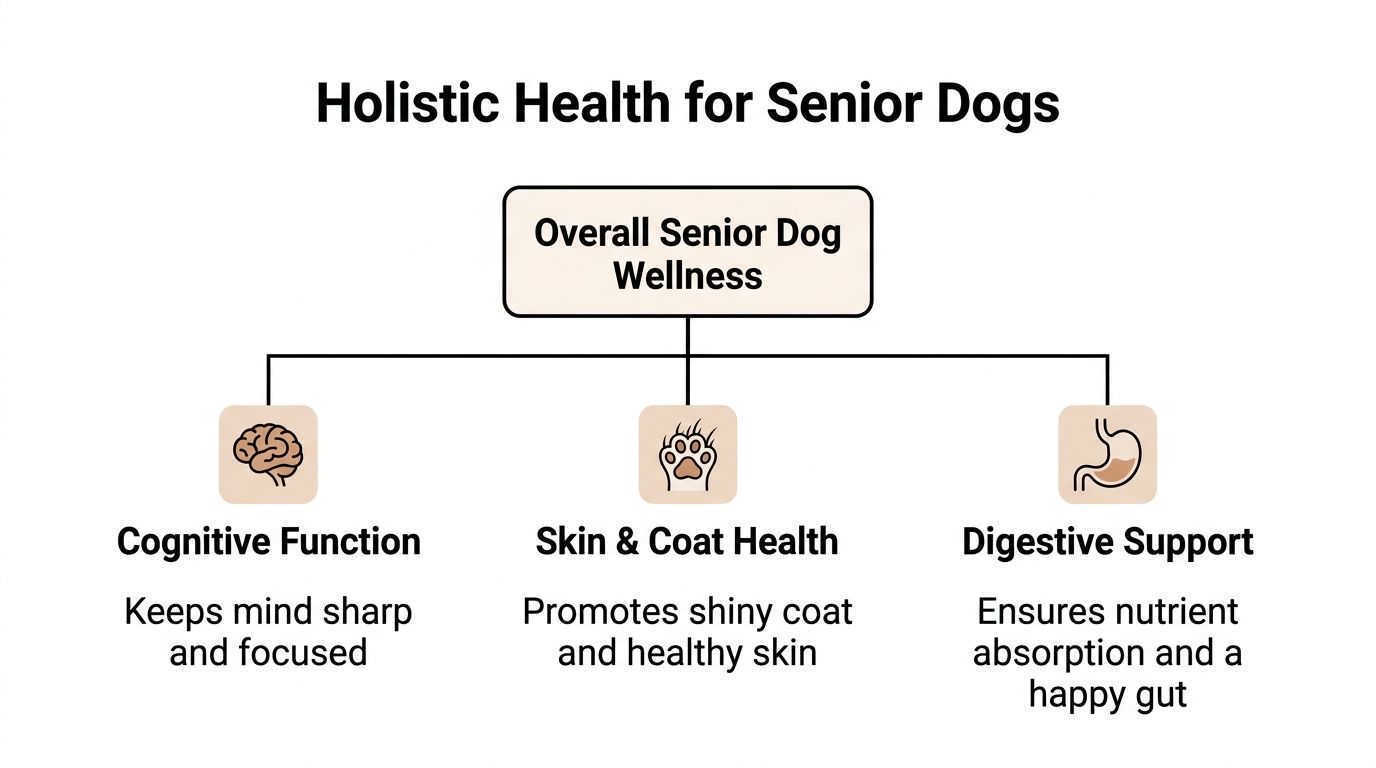
The healthy house idea
I like to explain this as a house with three priorities.
The brain is the control room.
The skin and coat are the weatherproofing.
The gut is the power plant.
When one area struggles, the whole house feels less stable.
Omega-3 fatty acids are often the most versatile option in this group because they support more than one system at once. They’re commonly used for skin and coat quality, and they’re also part of many plans for aging-brain support. In real life, that means the dog with a dry coat and mild cognitive changes may benefit from the same general category of supplement.
Probiotics and digestive enzymes belong to the gut side of the picture. If your dog’s stools vary from day to day, appetite seems uneven, or food changes cause trouble, digestive support may be more useful than a broad “senior formula.”
How to match symptoms to support
Use the clearest symptom cluster you see at home.
If your dog seems mentally less settled, think in terms of cognitive support plus omega-3s. If the most visible change is flaky skin or a rough coat, omega-3s often move to the top of the list. If the issue is gas, loose stool, or stomach sensitivity, start by discussing probiotics or digestive support.
A simple matching guide helps:
- Night restlessness or confusion suggests a brain-focused conversation
- Dry skin and dull fur point toward fatty acid support
- Sensitive stomach or inconsistent stools push digestive products higher on the list
- Picky eating with multiple mild changes may call for diet review before adding several supplements at once
Plain multivitamins can have a role, but they’re not a shortcut for identifying the underlying problem. If the coat is poor because the gut isn’t handling food well, or the dog seems withdrawn because movement hurts, a multivitamin won’t solve the main issue.
Support the system that’s failing first. Don’t hide a specific problem under a broad supplement.
That’s especially important with cognition. Owners sometimes describe a dog as “slowing down,” when the underlying issue is confusion, reversed sleep cycles, or discomfort. Those need different conversations and sometimes different tests.
How to Evaluate and Choose a Quality Supplement
Many owners get stuck at this point. The shelf is full of soft chews, powders, oils, and “advanced senior blends” with impressive packaging. A pretty label doesn’t tell you whether the product is well-made, clearly dosed, or a smart fit for your dog.

Read the front label, then the back label
The front tells you the promise. The back tells you whether that promise means anything.
Look for a product that clearly identifies its active ingredients, not just a vague proprietary blend. You want to know what’s in each chew, capsule, or pump. If a label makes it hard to tell how much glucosamine, chondroitin, EPA, or DHA your dog gets, move on.
Here’s a practical shopping checklist:
- Choose dog-specific products rather than adapting human supplements
- Look for quality markers such as third-party testing or recognized manufacturing standards
- Check active ingredients first and make sure they’re listed clearly
- Scan inactive ingredients for flavorings, fillers, or extras your dog may not tolerate
- Prefer clear dosing directions based on size or weight
Some owners look only at the ingredient list and forget the delivery form. That matters. A capsule your dog spits out every day is not a good supplement, even if the formula looks perfect on paper.
Think about your dog, not the marketing
A Great Dane and a Dachshund are both senior dogs, but their physical stresses are different. A large breed with stiffness may need a very different product emphasis from a small dog whose main issues are appetite, dental comfort, or digestion.
This is why “all-in-one senior support” can be hit or miss. Some dogs benefit from a broad product. Others do better with one targeted supplement chosen for the biggest problem. If your dog already eats a complete diet and feels good mentally, a skin-and-coat oil or joint supplement may make more sense than a multivitamin.
Brand familiarity can help when talking with your veterinarian. Products such as Nutramax Cosequin or fish-oil formulas with clearly stated EPA and DHA amounts are easier to discuss than mystery blends with unclear labels.
A quality supplement should answer three questions quickly: what’s in it, how much is in it, and why this dog needs it.
If the packaging can’t do that, it’s asking you to trust marketing instead of information.
Dosing Safely and Avoiding Harmful Interactions
The most common safety mistake isn’t malicious. It’s optimistic. Owners think, “It’s natural, so giving a little extra probably won’t hurt.” That assumption gets dogs into trouble.
Why more is not better
Supplements can act like medicine in the body. They can affect digestion, bleeding risk, appetite, and how other products are tolerated. This becomes especially important when owners “stack” several products that all contain overlapping ingredients.
According to VCA Hospitals’ discussion of supplements for older pets, 40% of senior dogs on multiple supplements can experience gastrointestinal upset. The same source notes that excess omega-3s with turmeric can increase bleeding risks, and some supplements are inappropriate for dogs with a history of conditions such as pancreatitis.
Those are real reasons to slow down. If your dog also takes prescription medications, especially pain medications or anti-inflammatories, your veterinarian needs the full list before you add anything else. This matters just as much as remembering routine health products, much like owners need accurate product guidance when choosing something as basic as the best dewormer for dogs.
A safe way to start
Don’t begin three new products on the same weekend. If your dog vomits, develops diarrhea, acts lethargic, or loses appetite, you won’t know which one caused it.
A safer approach looks like this:
Pick one target problem
Start with the issue affecting daily comfort most clearly.Use one new supplement at a time
Give your dog a fair trial without muddying the picture.Follow the label and your vet’s advice exactly
Don’t improvise because a chew “seems small.”Watch the stool, appetite, and energy
Digestive upset is often the first clue that a product or dose isn’t agreeing.Keep a simple log
Write down the product name, date started, dose, and any changes you notice.
Some veterinarians suggest easing into a new supplement rather than jumping to the full amount immediately, especially for dogs with sensitive stomachs. That’s often a sensible way to reduce early digestive complaints, but the plan should still fit the specific product and your dog’s history.
Bring every bottle, chew bag, oil pump, and powder scoop to your vet visit if you can. Labels solve arguments faster than memory.
That one habit prevents a lot of accidental overdosing and duplicated ingredients.
Your Vet Consultation Checklist
A good supplement conversation goes better when you walk in with observations instead of guesses. Your veterinarian doesn’t need a dramatic speech. They need a clear picture of what has changed, what your dog is taking, and what you want help with most.
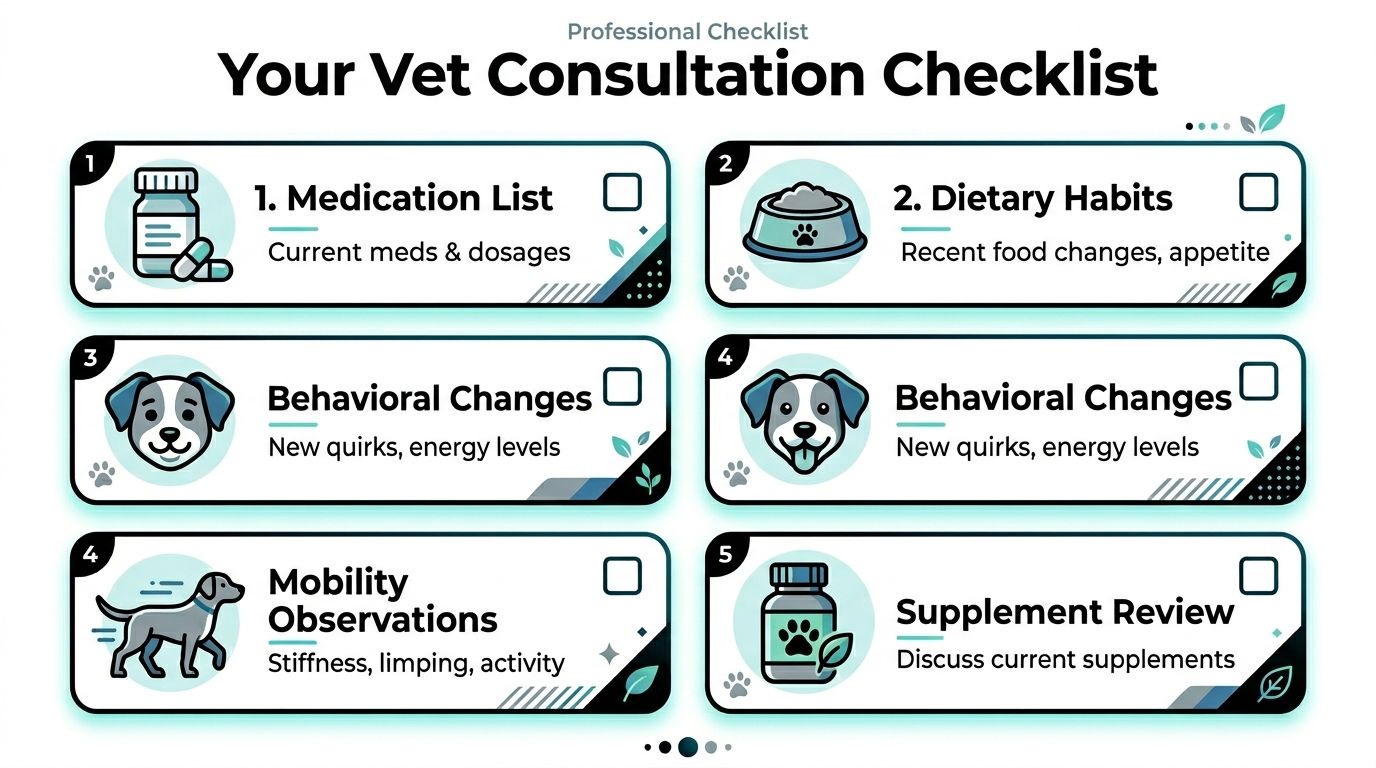
Bring this with you
Use this short checklist before your appointment:
Write down the main concern
Examples include stiffness after rest, dull coat, night pacing, gas, or loose stools.List every current product
Include medications, supplements, chews, oils, powders, and treats used for “health support.”Note when symptoms happen
Morning only, after exercise, after meals, overnight, or every day.Record food details
Brand, flavor, recent diet changes, appetite shifts, and anything new added at home.Ask focused questions
Try: “Which supplement category best fits my dog’s symptoms?”
Also ask: “Are there any ingredients you want me to avoid with my dog’s medical history?”Bring videos if needed
A short clip of your dog rising, walking, pacing, or struggling on stairs can be very helpful.
If your dog has had any new breathing effort, nighttime restlessness, or episodes that concern you, mention those too. Owners often dismiss those details even though they can change the whole plan. A symptom guide such as why a dog may be breathing heavy can help you describe what you’ve seen more clearly before the visit.
The best supplements for senior dogs are the ones chosen for the right reason, at the right dose, with the right supervision. That’s how you protect both comfort and safety.
If you want more practical pet-care guides written in plain language, visit MyPetGuider.com for everyday help with health questions, care routines, and smart product decisions for the pets you love.




Leave a Comment