

TL;DR: Yes, but with significant risks. Dogs can often handle raw chicken better than people because of their digestive physiology, but raw pet food contact was linked to 1,092 human salmonellosis cases from 2006 to 2019 and 20% to 40% of supermarket chicken can be contaminated with Salmonella according to Purina’s summary of CDC and USDA data. If you choose to feed raw chicken breast, strict sourcing, handling, and bone safety rules are essential.
You’re trimming chicken for dinner, your dog is sitting at your feet, and one clean piece of raw chicken breast seems harmless. A lot of owners end up in that exact moment. They’ve heard that dogs are “built for raw,” but they’ve also heard warnings about bacteria, choking, and emergency vet visits.
Both sides contain part of the truth.
Raw chicken breast isn’t automatically poison, and it isn’t automatically safe. The answer depends on which chicken, which dog, which household, and how carefully you handle it. That’s where many articles stop short. They say yes or no, but they don’t give you a workable framework.
This guide does. I’m going to treat this the same way I would in a clinic conversation with a thoughtful new dog owner: plainly, carefully, and with your dog’s safety first.
Table of Contents
- The Raw Chicken Question Every Dog Owner Asks
- The Core Debate A Balanced Look at Pros and Cons
- Biggest Risks Explained Pathogens and Bone Hazards
- How to Prepare Raw Chicken Safely A Step-by-Step Guide
- When Raw Chicken Should Never Be on the Menu
- Safer Alternatives and When to Consult Your Vet
- Frequently Asked Questions About Raw Chicken
The Raw Chicken Question Every Dog Owner Asks
Most owners who ask, “can dogs eat raw chicken breast?” aren’t trying to be reckless. They’re trying to do something healthy. They may have a dog with a sensitive stomach, a picky appetite, or a friend who swears raw feeding changed everything.
I’ve also seen the opposite. An owner gives a small raw piece as a treat because it seems natural, then spends the next day worrying about diarrhea, bacteria on the kitchen floor, and whether the dog licked the toddler’s hands.
That tension is why this topic gets so confusing. The internet tends to split into two camps. One side talks as if raw chicken is what every dog was meant to eat. The other talks as if one bite will always lead to disaster. Real life sits in the middle.
Good decisions in pet nutrition usually come from asking better questions, not from chasing a simple yes or no.
A useful starting point is this: dogs aren’t tiny humans, but they also don’t live like wolves. They share our homes, sleep on our couches, and lick our hands and faces. That household reality matters just as much as canine biology. If you’ve ever wondered whether normal dog germs are already a concern, this piece on whether dogs’ mouths are cleaner than humans’ adds some helpful context.
Here’s the practical way to approach the subject:
- Your dog’s body matters: A healthy adult dog may tolerate raw food very differently from a puppy or senior.
- Your kitchen matters: Safe handling changes the risk.
- Your source matters: Commercially prepared raw and random supermarket chicken are not the same choice.
- Your goal matters: A tiny topper is different from building a full raw diet.
The Core Debate A Balanced Look at Pros and Cons
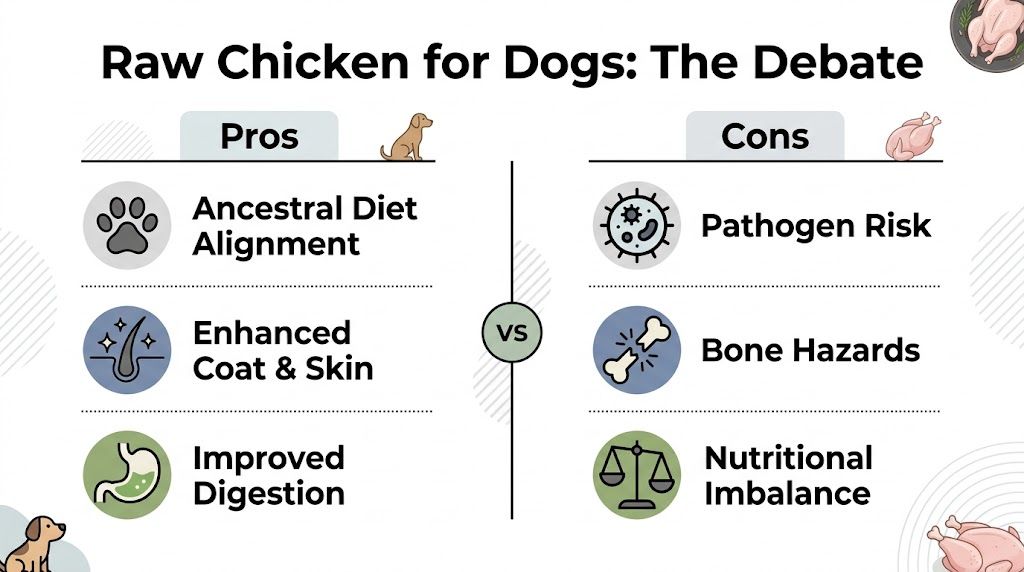
Raw feeding became more popular after the post-1993 BARF model, which framed dogs as animals that should eat more like their wild ancestors. Supporters often point to dogs’ digestive adaptations, including stomach acid with a pH of 1 to 2, and a Nature’s Menu summary of a University of Helsinki finding notes that with commercially prepared raw food and proper hygiene, home cross-contamination risk can be as low as 6%, compared with up to 40% with improper DIY raw preparation.
Why some owners choose raw
The attraction is easy to understand. Raw chicken breast is a simple, recognizable food. Owners like that they can see exactly what they’re feeding. Some also feel that less processing must mean better nutrition.
A healthy dog’s digestive system is built to handle bacterial exposure better than a human digestive system can. That doesn’t erase risk, but it helps explain why some dogs eat raw meat and appear completely fine. For some owners, that lived experience becomes very persuasive.
Here’s the strongest version of the pro-raw argument:
| Aspect | Potential Pros | Significant Cons |
|---|---|---|
| Digestive fit | Matches the idea of an ancestral diet | Tolerance varies from dog to dog |
| Ingredient simplicity | One plain protein is easy to identify | Plain breast alone is not a complete diet |
| Commercial raw options | Better safety controls than DIY in some cases | Quality differs widely between brands |
| Owner perception | Feels less processed and more natural | “Natural” doesn’t always mean low-risk |
Why many veterinarians stay cautious
Veterinarians tend to look beyond whether the dog can digest raw chicken. We also ask what happens in the house around that dog. A dog may feel well and still shed bacteria into its environment. That changes the discussion from “Can the dog eat this?” to “Is this an acceptable household risk?”
Another concern is that raw chicken breast by itself is not nutritionally complete. Even if it’s tolerated, feeding plain breast too often can create an unbalanced diet over time. Owners sometimes confuse “a safe treat” with “a complete feeding plan.”
Practical rule: If a food requires perfect sourcing, careful sanitation, strict storage, and a healthy low-risk household to be a reasonable option, it isn’t a casual treat.
So the balanced answer is this. Raw chicken breast can fit into some dogs’ diets, but it’s not something I’d hand out casually from a cutting board. The safer the sourcing and the tighter the kitchen routine, the more defensible the decision becomes.
Biggest Risks Explained Pathogens and Bone Hazards
A dog can eat raw chicken and look completely fine, while the problem ends up on your kitchen floor, your hands, or a child’s face after a lick. That is why this part of the raw chicken debate trips up so many thoughtful owners. We tend to watch the dog for stomach upset, but the risk often starts earlier and spreads wider.
The pathogen risk extends beyond the bowl
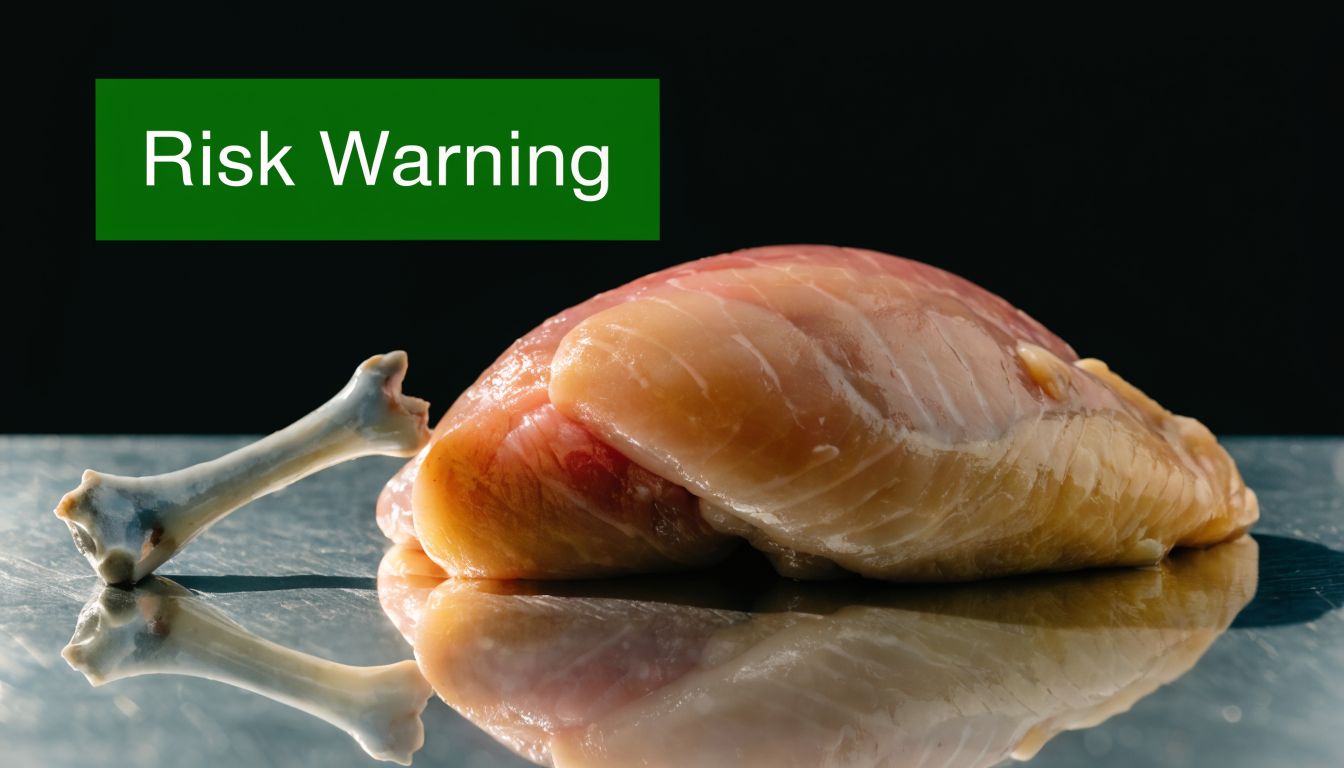
Raw chicken carries two separate questions. Can your dog tolerate it? Can your household tolerate the contamination risk that comes with it? Those are not the same question.
As noted earlier from the same Purina review of CDC and USDA figures, human salmonellosis cases have been linked to raw pet food contact, and supermarket chicken may carry Salmonella at meaningful rates. The practical takeaway is simple. Chicken that looks fresh and clean can still contain bacteria you cannot see, smell, or rinse away.
That matters because exposure rarely stays neatly inside the bowl. It spreads in ordinary, easy-to-miss ways. A dog eats, licks its lips, noses a toy, walks across the floor, then asks for attention. The chain of contact is what worries veterinarians, especially in homes with young children, older adults, pregnant family members, or anyone with a weakened immune system.
Common trouble spots include:
- The feeding zone: saliva, bowl residue, and tiny meat droplets can contaminate nearby surfaces
- Hands and handles: owners prep food, then touch faucets, phones, cabinet pulls, or their face
- Stool and fur: a dog may seem normal but still shed organisms into the home
- Shared supplies: dish cloths, sponges, cutting boards, and prep knives can spread bacteria if they are reused
Pathogen control starts before the first bite. Source matters. A commercially prepared raw product that uses high-pressure processing has a different risk profile than a random supermarket package, because one has gone through a pathogen-reduction step and the other usually has not. That does not make HPP raw risk-free, but it changes the conversation from blind trust to managed risk.
Bones create a different kind of emergency
Bacteria are one problem. Bones are another.
Once bone is attached to the chicken, you are no longer only thinking about infection. You are also dealing with choking, mouth injury, esophageal irritation, broken teeth, and intestinal blockage. That shift matters because a dog does not have to get sick slowly for this to become serious. A fast gulper can turn one excited swallow into an urgent trip to the clinic.
As noted earlier in the same Purina article, veterinary concern around raw chicken bones includes choking and splinter-related gastrointestinal injury. The exact outcome depends on the size of the dog, the size of the piece, and how the dog eats. A careful chewer and a food-inhaling Labrador do not bring the same level of risk to the bowl.
Owners often hear that cooked bones are the dangerous ones, then assume raw bones are safe. The better way to frame it is this: cooked bones are widely known to be hazardous, and raw bones still carry mechanical risk. They can lodge, scrape, crack teeth, or block the digestive tract. If a dog swallows a chunk whole, you may be dealing with the same kind of foreign-body problem discussed in this guide to signs of a dog intestinal blockage.
Here is the clinic-level rule I give owners who are considering raw chicken breast:
- Use boneless chicken only
- Inspect every piece yourself
- Skip raw chicken for dogs that gulp, guard food, or panic-eat
- Treat any coughing, retching, repeated vomiting, or abdominal pain after eating as a veterinary concern
If you remember one principle from this section, make it this one. Raw chicken risk is not just about whether a dog can digest it. It is about whether you can control invisible bacteria and avoid a preventable mechanical injury.
How to Prepare Raw Chicken Safely A Step-by-Step Guide
You are standing in your kitchen with a package of raw chicken in one hand and your dog watching every move. This is the moment where safety is decided. For most owners, the biggest difference is not the recipe. It is the source of the meat and the routine you follow every single time.
Start with the source, not the seasoning
Raw chicken is not one uniform product. Supermarket chicken and a commercial raw diet made with pathogen-reduction steps do not carry the same level of risk.
As noted earlier, We Feed Raw explains that high-pressure processing, or HPP, can greatly reduce harmful bacteria without cooking the meat. That matters because HPP adds a safety step you do not get from an ordinary grocery-store pack. If an owner is set on feeding raw, I would rather see them choose an HPP-treated commercial raw product than prepare plain supermarket chicken at home.
Use this decision framework:
- Choose HPP-treated commercial raw first. It adds a meaningful barrier against bacterial contamination.
- Pause if the product is only labeled "human-grade." That term speaks to sourcing standards, not pathogen control.
- Use lean, plain chicken breast. Skip skin, drippings, marinades, and fatty trimmings.
- Keep it boneless. One avoidable risk is enough.
A simple comparison helps here. HPP works like a built-in safety filter. Supermarket raw chicken asks you to manage all of that risk yourself in your own kitchen.
Build a kitchen routine you can repeat
Raw feeding is safest when the process is boring. You want a routine so clear that you follow it the same way when you are rushed after work as you do on a quiet weekend morning.
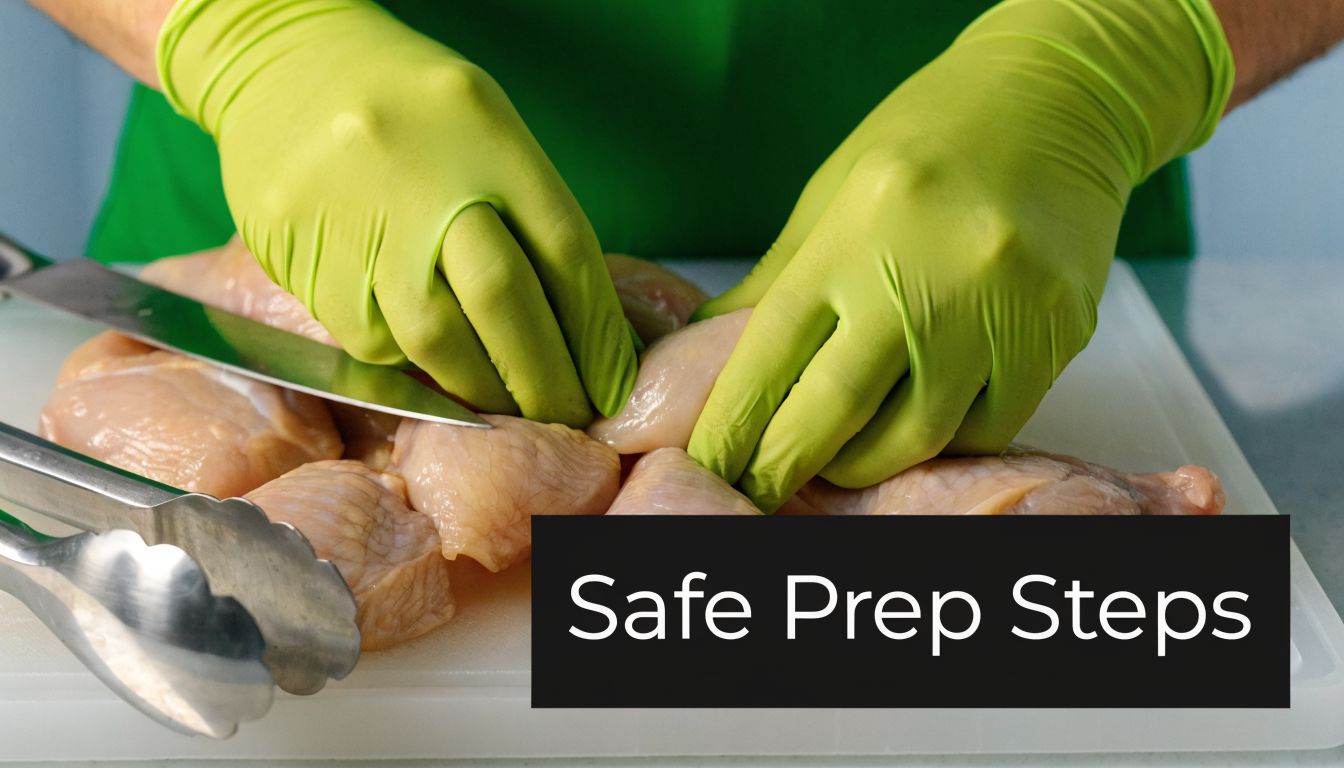
Set aside one cutting board, one bowl, and one prep area for the dog's raw food. Feed in a spot you can disinfect easily, such as a mat on tile or another hard surface. Do not let raw pieces travel through the house on carpet, bedding, or furniture.
- Before prep: Wash your hands, clear the counter, and keep children away from the feeding area.
- During prep: Portion only what you will feed. Keep raw juices away from human food, dishes, and utensils.
- At feeding time: Serve it right away in a washable bowl.
- After feeding: Remove leftovers promptly. Wash the bowl, prep tools, and nearby surfaces with hot, soapy water.
Clinic advice: The best raw-feeding routine is the one you can perform correctly every time, even when you are tired or distracted.
This video gives a useful visual overview of safe raw food handling habits at home:
Introduce it slowly and watch the dog, not the trend
A dog's digestive system often does better with change in small steps. The same We Feed Raw guidance recommends a gradual transition over 7 to 10 days rather than a sudden switch. That gives you time to spot a problem early instead of discovering it after a full bowl.
Start with a small amount. Then watch the signals that matter: stool quality, appetite, energy, vomiting, and obvious abdominal discomfort. If any of those go in the wrong direction, stop and call your veterinarian before trying again.
That applies whether you are feeding a complete commercial raw food or using a small amount of raw chicken breast as a topper.
| Step | What to do | Why it matters |
|---|---|---|
| Source | Pick HPP-treated raw | Lowers bacterial risk |
| Portion | Start with a small amount | Makes digestive upset easier to spot |
| Form | Use boneless breast only | Reduces mechanical risk |
| Monitoring | Watch stool and behavior | Helps you catch intolerance early |
| Cleanup | Sanitize bowl and surfaces | Protects people in the home |
When Raw Chicken Should Never Be on the Menu
Some dogs and some homes aren’t good candidates for raw poultry. This isn’t about being overly cautious. It’s about choosing the safer option when the downside is too serious.
Dogs that need a safer path
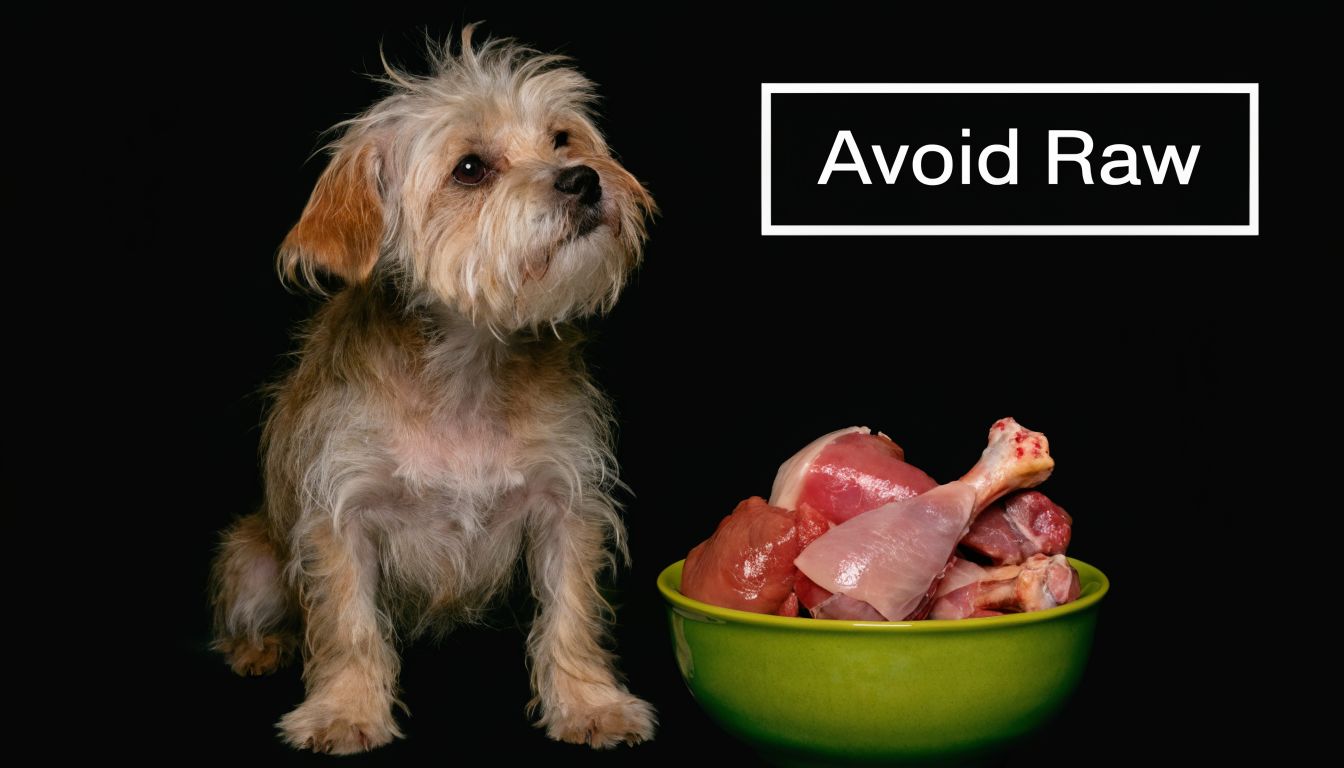
I don’t recommend raw chicken breast for dogs whose bodies are less equipped to handle dietary stress or bacterial exposure. That includes puppies, senior dogs, immunocompromised dogs, and dogs with a history of digestive disease.
Dogs with pancreatitis concerns also deserve extra caution, especially if owners are feeding chicken with skin or fatty trimmings instead of plain lean breast. A dog that already struggles with the gastrointestinal tract doesn’t need an unnecessary experiment.
Avoid raw chicken if your dog is:
- Very young: Puppies have immature systems and can decompensate faster.
- Older or frail: Seniors often have less reserve when illness hits.
- Medically fragile: Dogs on chemotherapy or with immune compromise need lower-risk food choices.
- Digestively sensitive: Dogs with repeated vomiting, diarrhea, or prior pancreatitis should stay on safer diets.
Households where raw feeding is a poor tradeoff
Sometimes the dog could tolerate raw, but the humans in the house shouldn’t have to absorb the risk. If you have a toddler, an elderly family member, someone who is pregnant, or someone with a weakened immune system at home, raw chicken usually isn’t worth it.
The same goes for chaotic households where food prep is rushed, counters are shared, and pets roam through the kitchen during cooking. Raw feeding requires discipline. If the environment makes discipline unlikely, choose a safer protein form.
When the household is high-risk, “my dog might be fine” isn’t a strong enough reason to feed raw poultry.
Safer Alternatives and When to Consult Your Vet
A lot of owners read through the risks and decide they still want chicken, just not the bacterial gamble. That’s a very reasonable conclusion.
If you want the protein without the bacterial risk
The simplest alternative is plain cooked chicken breast. Boiled or baked chicken with no seasoning, sauces, onions, or garlic gives you the same familiar protein in a much safer format. For many dogs, that’s the best compromise.
Another option is a commercial raw diet that uses HPP, especially for owners who strongly prefer a raw approach but want stronger safety controls than home-prepped supermarket meat can offer. If you go that route, choose products formulated to be complete and balanced rather than feeding plain chicken breast as a stand-alone food.
You can also use cooked chicken as part of a rotation with other safe foods. If you’re looking for gentle add-ins, this guide on whether dogs can eat collard greens may help you think more broadly about balanced toppers.
Nutrition matters beyond raw versus cooked
There’s another detail many raw chicken articles skip. A Bella & Duke discussion of chicken fat and skin balance notes that the omega-6 to omega-3 ratio in modern farmed chicken can be as high as 20:1, compared with an ideal 1:1 in wild prey. In practical terms, that means a chicken-heavy diet, especially one that includes skin and fat, may push some dogs toward more inflammation or allergy flares.
That doesn’t mean chicken is bad. It means chicken shouldn’t dominate the whole diet without thought. Lean cuts, variety, and veterinary guidance matter.
Talk to your vet before making raw chicken a regular part of your dog’s diet if your dog has allergies, recurring gastrointestinal problems, or any chronic disease. If you want a homemade diet long-term, ask for a referral to a board-certified veterinary nutritionist.
Frequently Asked Questions About Raw Chicken
Can dogs eat raw chicken breast straight from the freezer
Frozen chicken isn’t automatically safer just because it’s cold. Freezing may help with storage, but it doesn’t replace careful sourcing and sanitation. If you use raw chicken, thaw it safely and serve it in a way your dog can chew without gulping.
Is raw chicken breast safer than raw chicken with bones
Yes. If you’re comparing the two, boneless breast is safer because it removes the added choking and injury risk that comes with bone. Raw chicken bones are not something I consider a casual or beginner-friendly choice.
How much raw chicken breast should I feed
For most owners, the safest way to use it is as a small topper or occasional treat, not a full diet built from plain breast alone. Portion depends on your dog’s size, current diet, health history, and whether the rest of the diet is balanced.
What signs mean my dog may not be tolerating it
Watch for vomiting, diarrhea, low energy, abdominal discomfort, straining, repeated licking of the lips, or a sudden drop in appetite. If bone exposure is possible, also watch for gagging, repeated swallowing, or trouble passing stool.
Should I try raw chicken if my dog has a sensitive stomach
Usually, no. Many owners reach for raw because they hope it will be gentler, but sensitive dogs often do better with a predictable, balanced, cooked diet. If your dog has chronic digestive issues, get your veterinarian involved before experimenting.
What’s the safest bottom line
If you want the shortest practical answer to “can dogs eat raw chicken breast,” it’s this: they can, but only under controlled conditions, with boneless chicken, careful handling, and thoughtful sourcing. For many households, cooked chicken or an HPP-treated commercial diet is the better choice.
If you want more practical, plain-English pet care guides, visit MyPetGuider.com. You’ll find helpful articles that make day-to-day decisions easier, whether you’re choosing foods, handling common health questions, or building safer routines for your dog.




Leave a Comment